Posted on Leave a comment

Making a Belt with Billy and Charlie

Are you leveling up your appearance with a new belt? We have useful advice on how to make it successfully the first time! This tutorial shows you how we cut the leather, attach buckles, attach chapes, install eyelets, and put in studs. Enjoy – and do write us at billy@billyandcharlie.com if you have a question! We will answer you and improve this post if we see where we should explain something better.
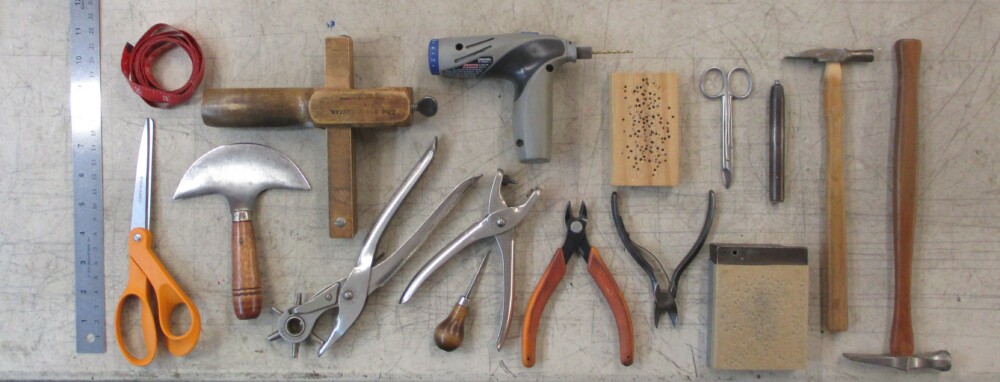
These are the tools we use when making a belt. You may not need all of them and you can substitute/make do for some. From left to right: Ruler, tape measure, scissors, head knife, strap cutter, rotary leather punch, small leather punch, awl, drill, wooden block to drill into, two sorts of rivet cutters (you only need one), fingernail scissors, rivet setter, anvil, cross peen hammer (two examples: the one on the left is the sort you can readily buy at a jewelers supply).

Notes:
Our rivets fit in holes drilled with a 3/32″ (2.4 mm) drill bit.
Your anvil can be any piece of heavy steel. You should pad it with a piece of cardboard like that on the back of a pad of paper or a notebook cover. Do not use leather or corrugated cardboard as a cushion – they are too soft and many buckles and studs will deform in riveting.

Because we make a lot of belts, we use a standard form to make sure we don’t forget anything. When you make your belt, you should plan it entirely before you even cut the leather – how far the eyelets will be from the buckle, how long a tail you will have, the spacing of any studs. If it is at all complex, we recommend working it out on a large piece of paper at full scale ahead of time.
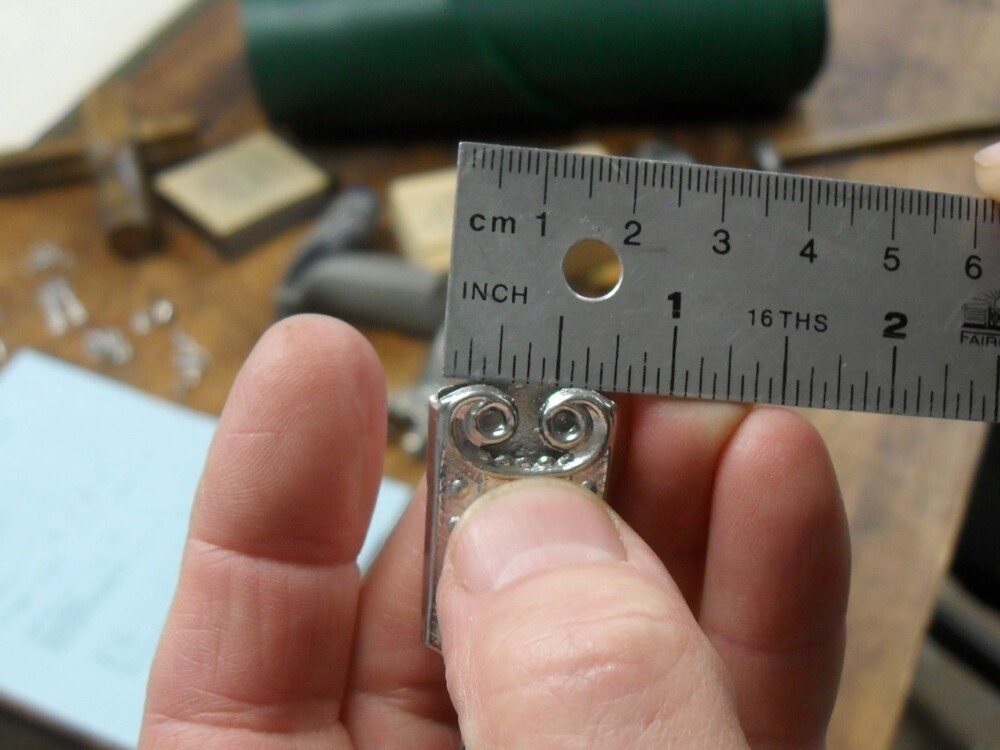
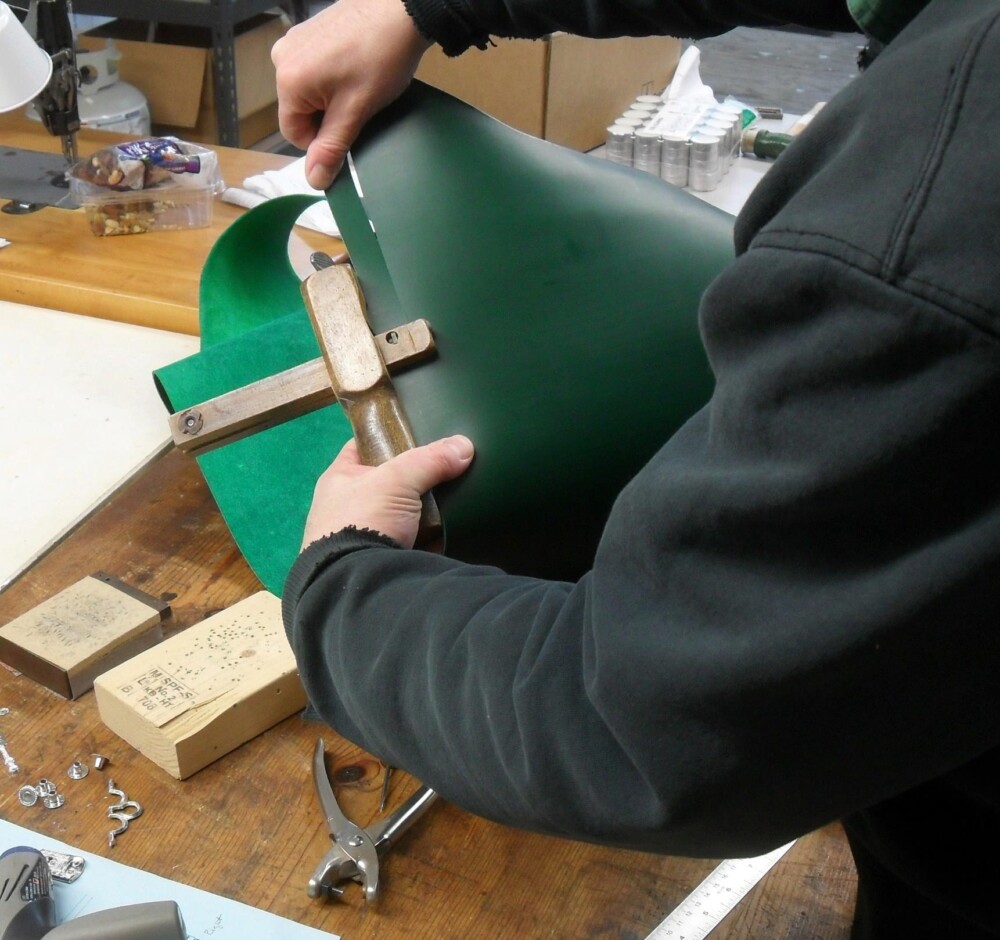
We measure the strap width…..
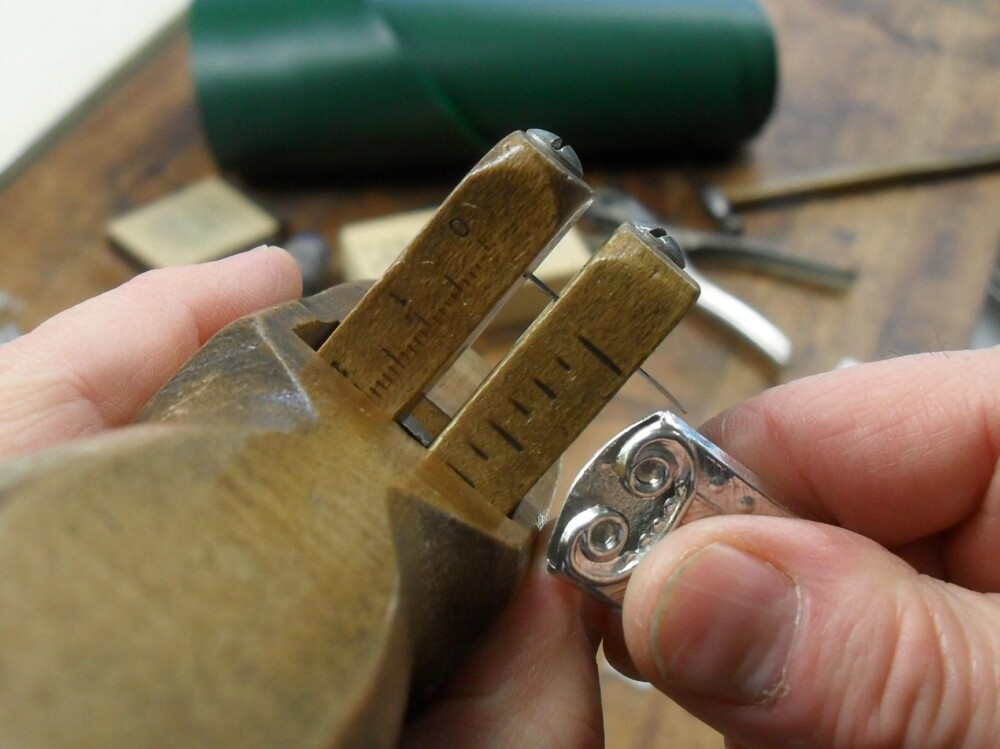
….and measure it a second time against the strap cutter……
…. because we only want to cut once. All of our buckles and chapes have information on the product page about the width of strap they take, but it is best to check physically to get the precise measurement.
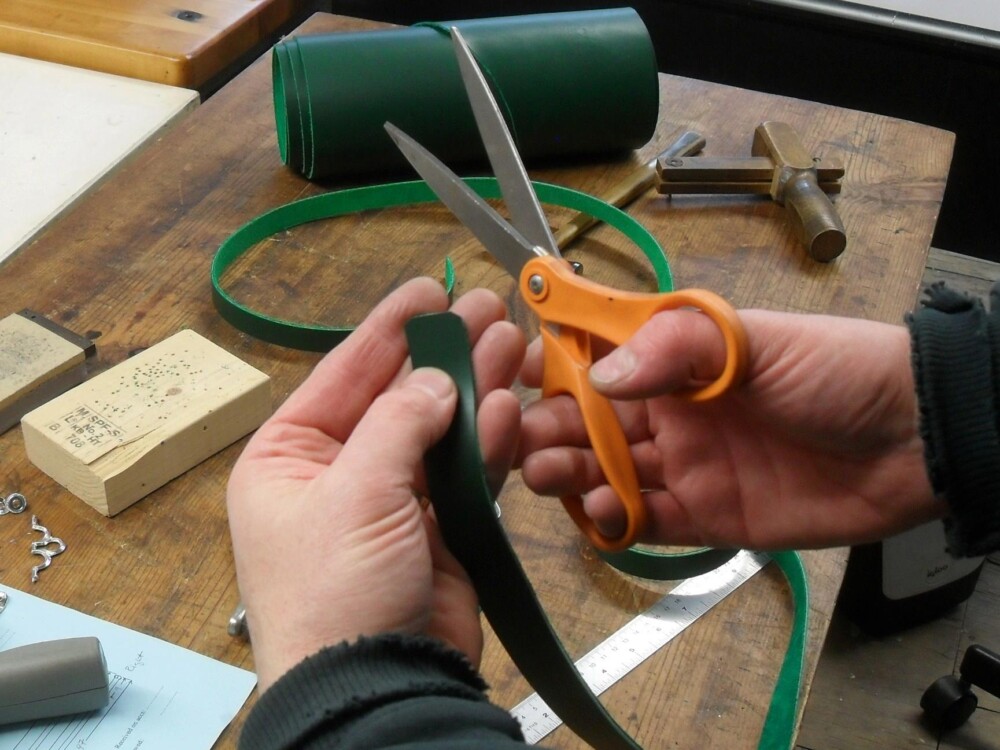
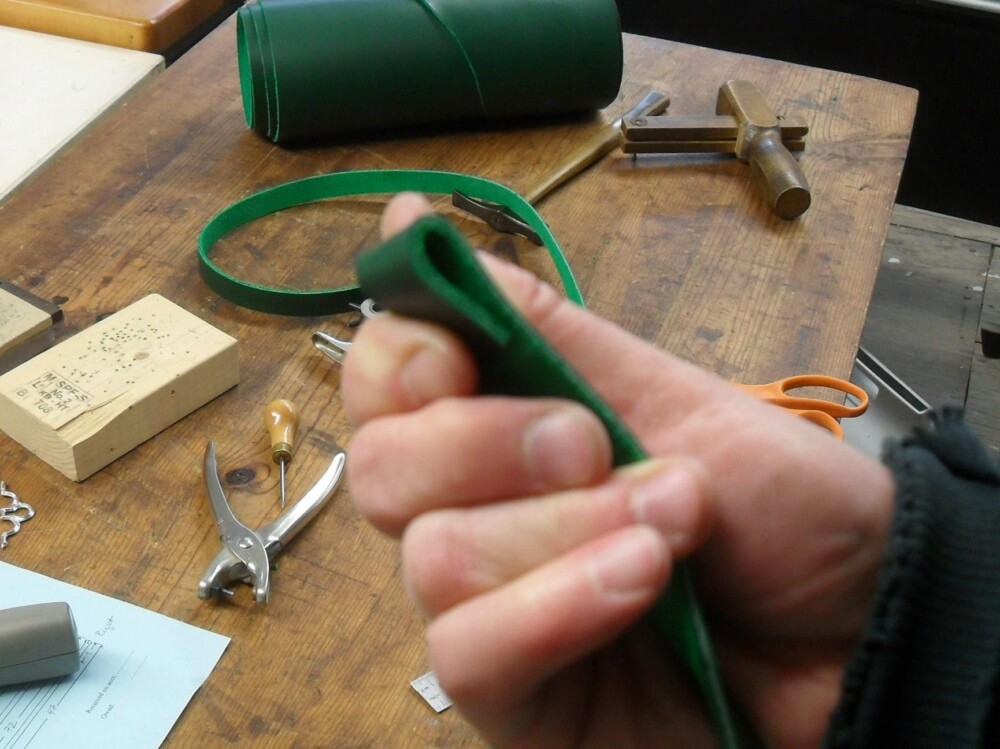
Attaching the buckle. Mac nicks off the corners of the strap so it will be neat. For this buckle, the strap is going to loop through…
… at the point where Mac is folding the leather. (Buckles that have openings the strap plugs into are installed like the chape shown below.)
Our buckles and chapes are sized like medieval originals, so the leather that fits them is lighter than the heavy leather you may see people using for belts – 5 or 6 or 7 ounce, which translates to 3/32″ to 1/8″ thick (2.4-2.8 mm). If you have a leather that is too heavy you can thin it out with a splitter if you have one. (This is not shown, because we do not stock very heavy leather and it is not part of our normal procedure.)
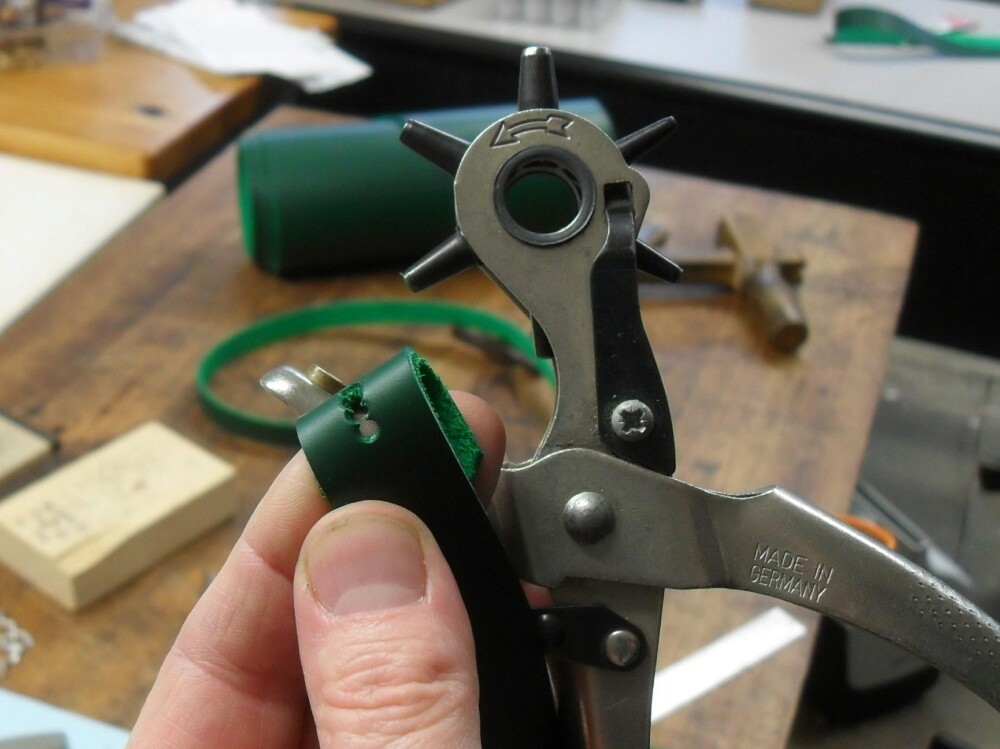
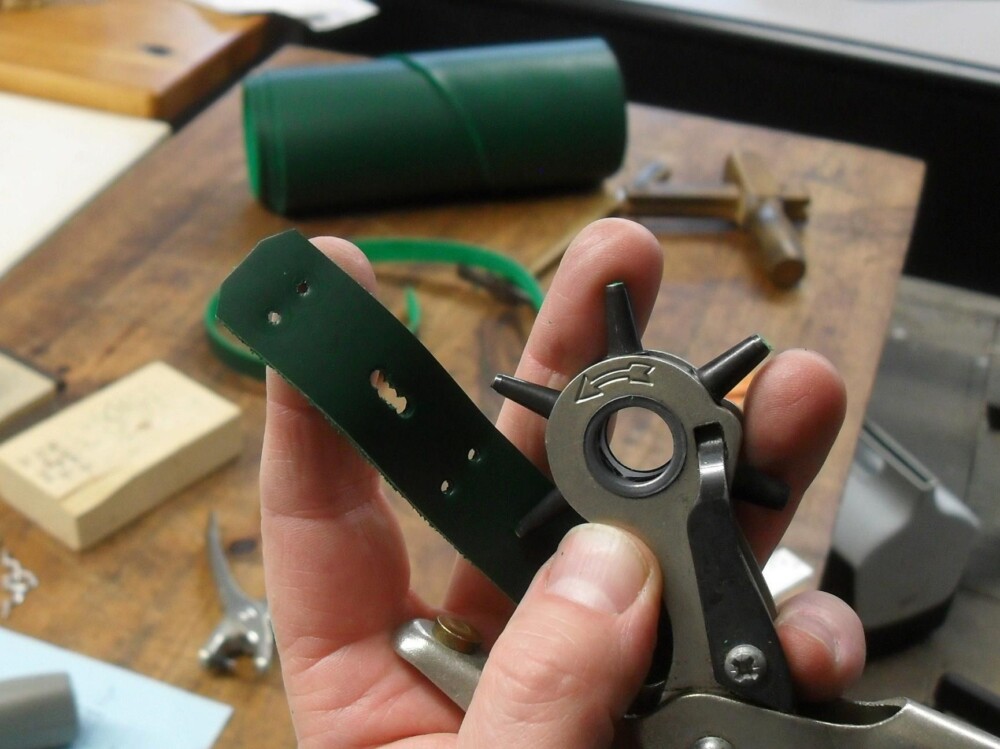
We use a rotary leather punch to make the hole the buckle tongue will go through, and extend the hole with additional punch “bites” along the top of the strap, so the tongue can move freely in the slot. If you have specialized leather-working tools, you may have a slot punch that cuts out a long straight sided hole, but you can make do with just a rotary punch as we do.
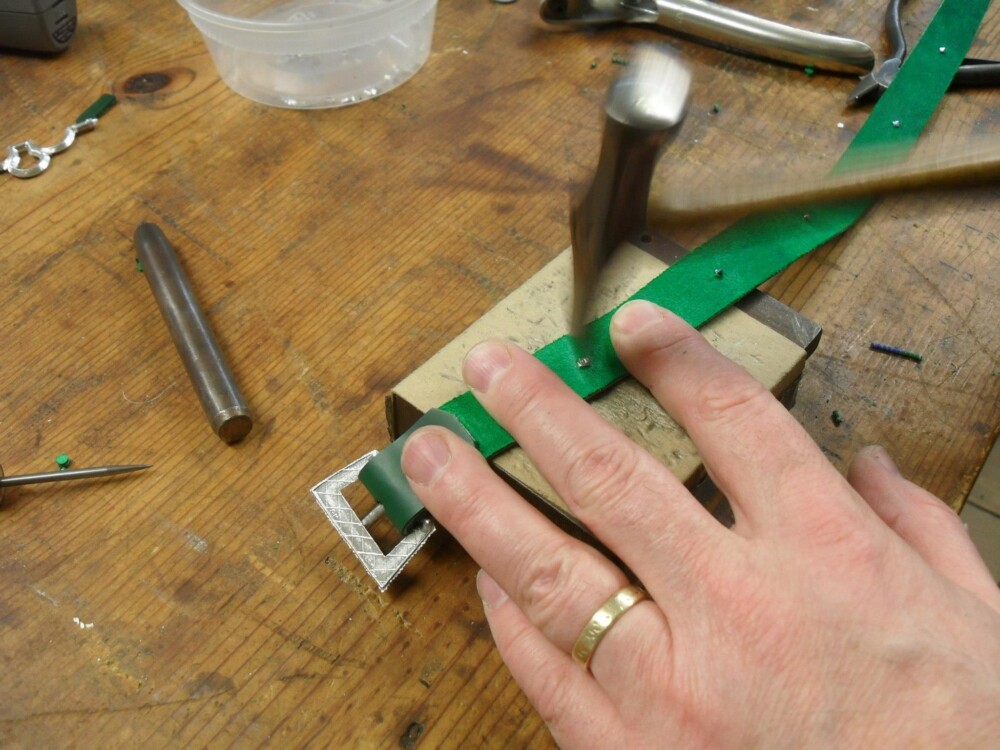
While the strap was folded, Mac punched the holes for the rivets also, using the small leather punch. These must be small enough that the rivet has to be pushed pretty hard to fit in. Use an awl if your punch is too large.
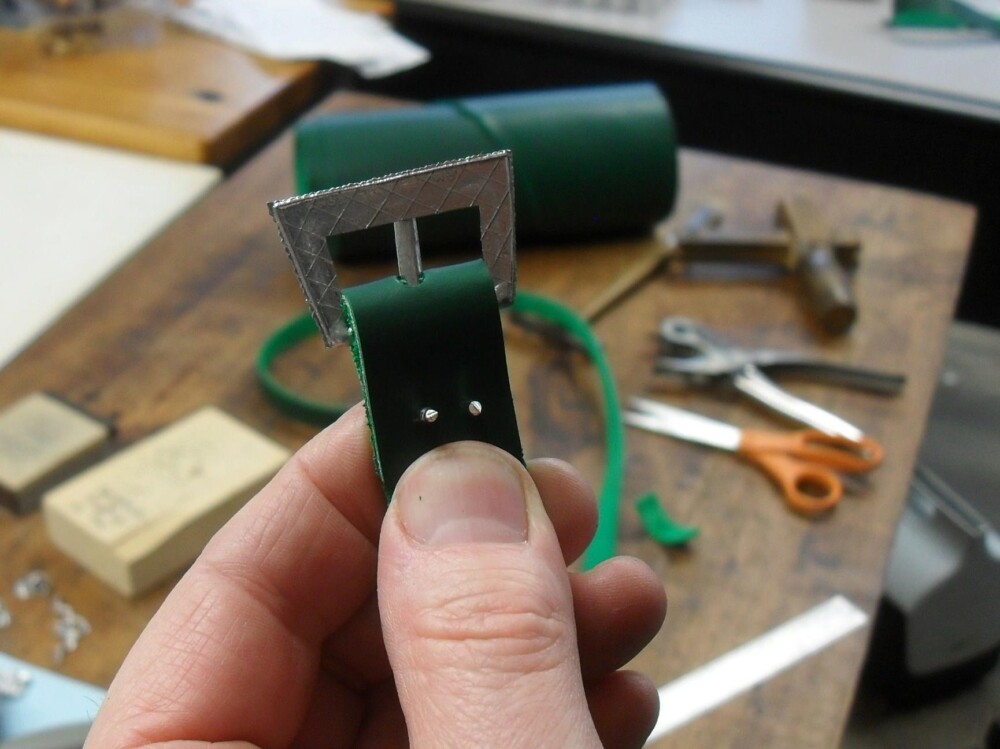
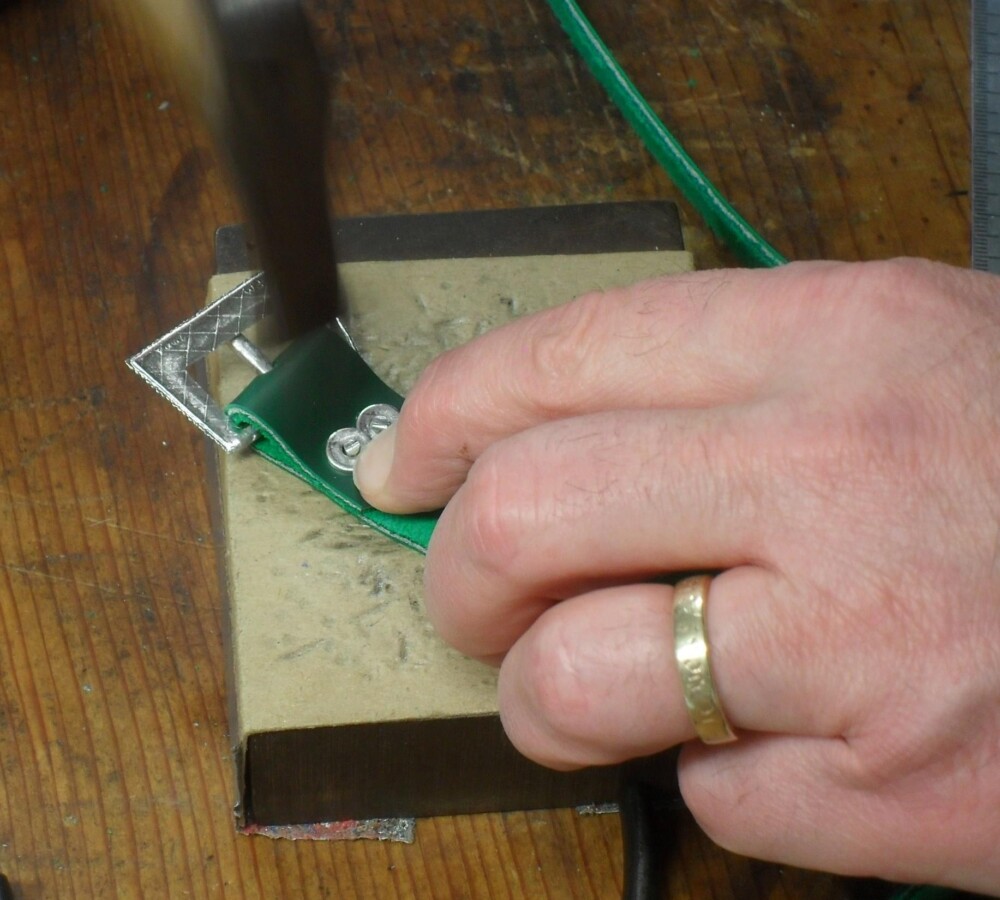
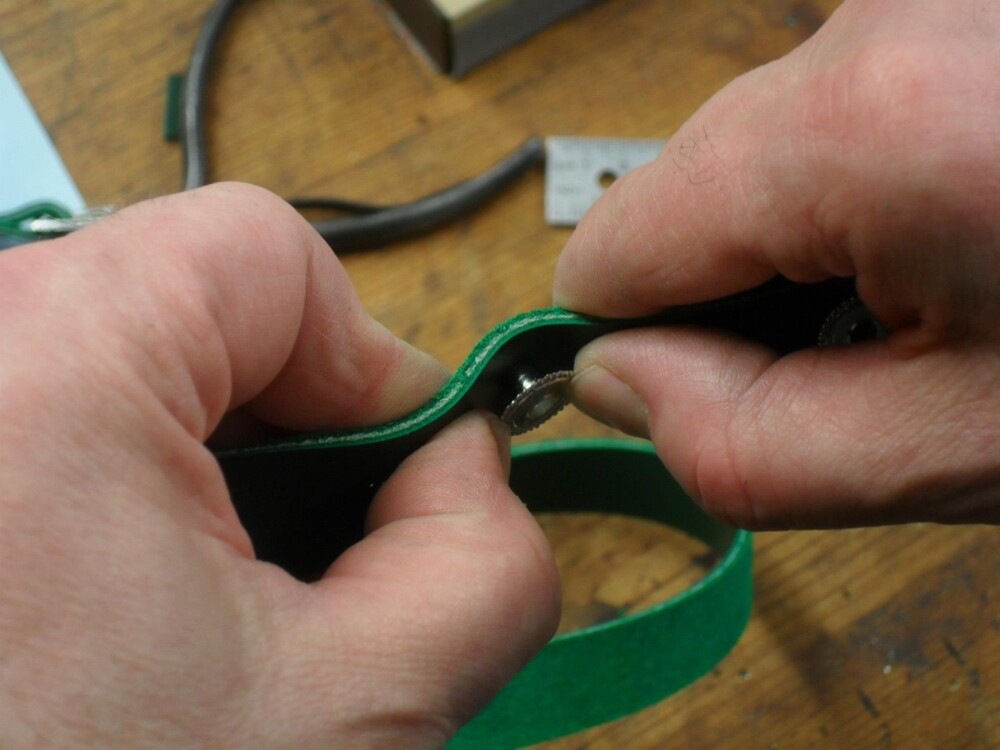
The rivets put through the holes.
The heads of these rivets are larger than the holes we punched for them, but they need something broad on the back also to be strong, so we use washers/roves to peen them up against. The rivet is cut quite short, then peened up with a riveting hammer and a dozen or twenty little taps. For a more complete description of how to spread the metal of the rivet out over the washers, check out either our blog post, Getting Crafty with Billy and Charlie: Belt Studs, or our post Attaching a Nick Rolin Chape.

Buckles with sockets the leather fits into are put on in the same way as chapes – see below.
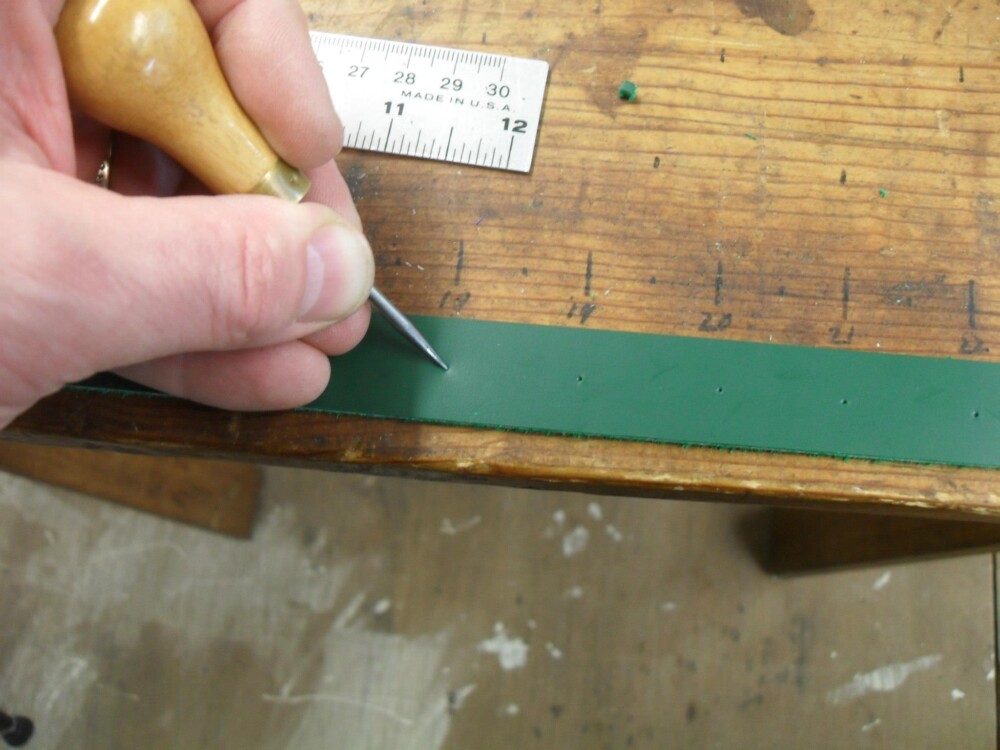
We strongly recommend using eyelets to protect the leather from the tongue of the buckle (and our standard suggestion is to put one eyelet at the length you want to wear the belt and two more to either side). Here we show how to install tube eyelets that pass through the belt and are hammered to spread and smooth them. We recommend you lay out the entire belt first, figure out where the eyelets will go, and install them before you put in the studs. We like one inch (25mm) spacing between the eyelets for belts. We usually use an awl to make light marks where we will punch later, but you can use a pencil or pen, etc.
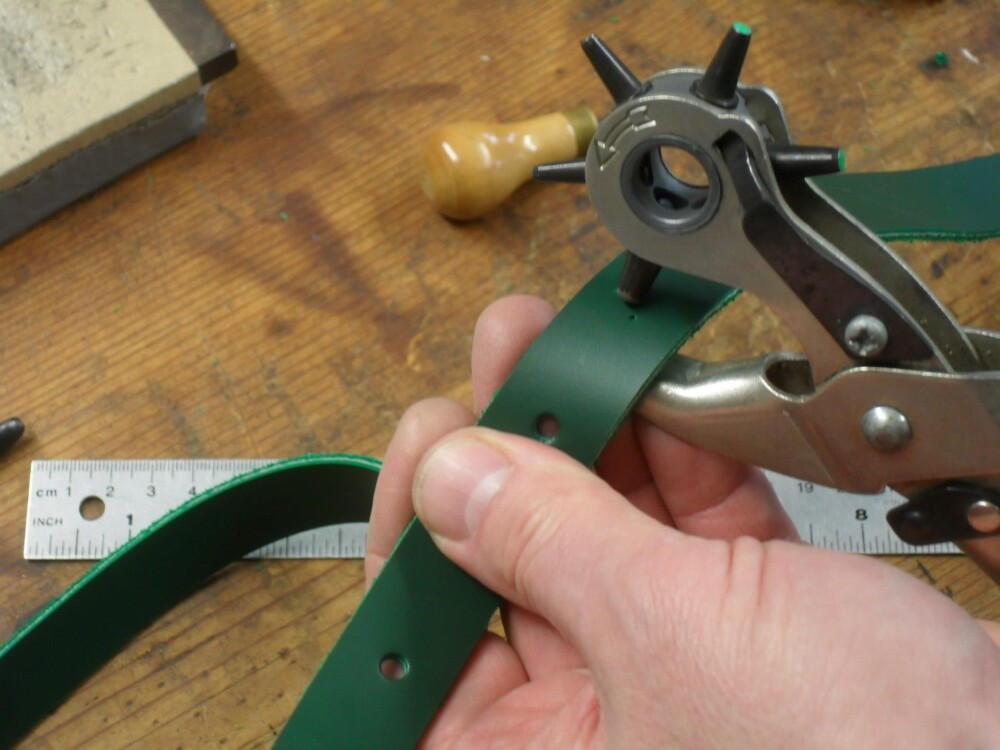
Punch holes for the eyelets. The hole should be just vaguely smaller than the eyelet “tube”…
…. so it needs to be pressed hard to go in.
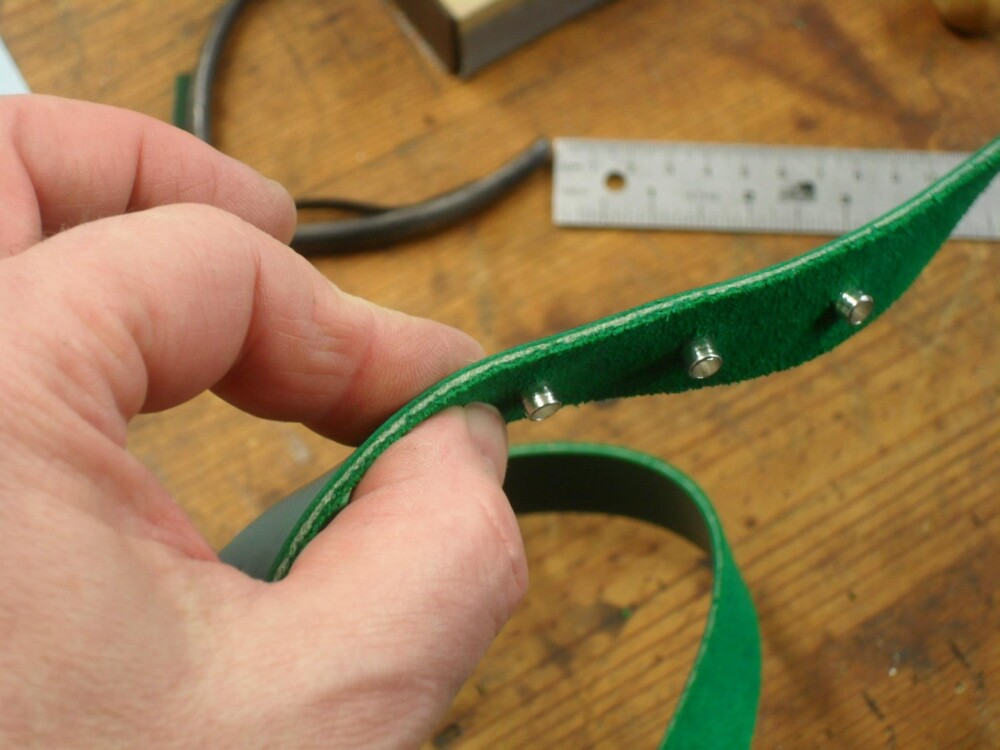
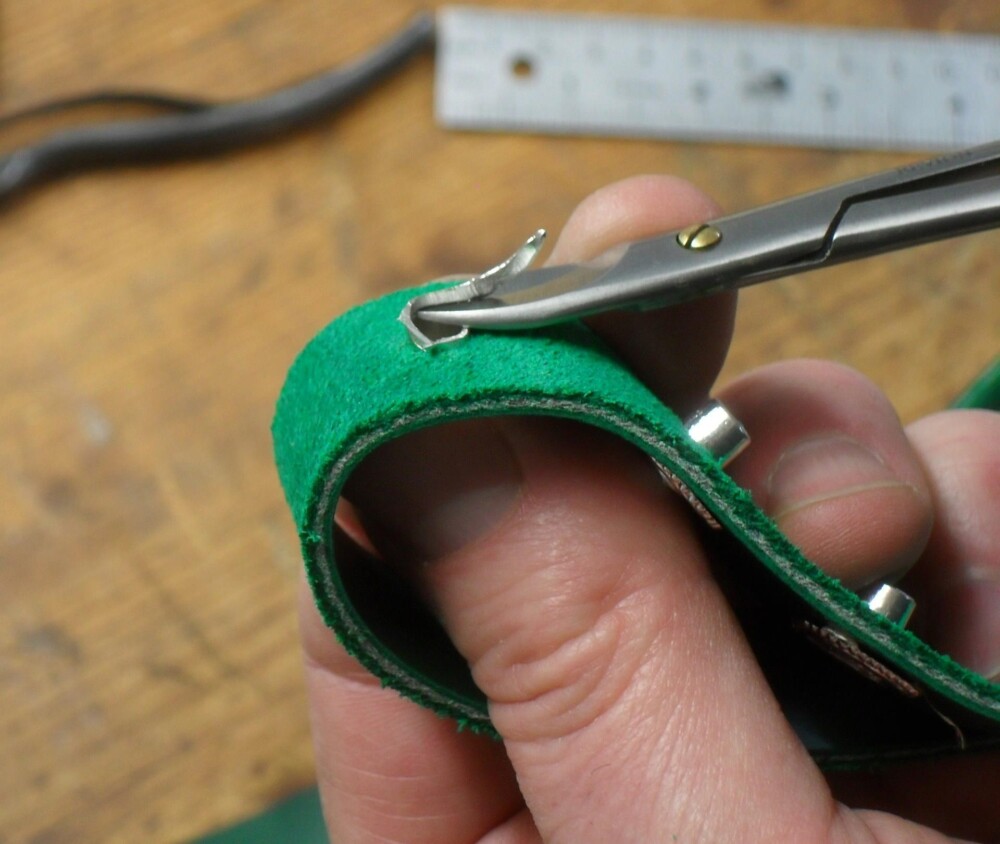
The tubes are almost always too long to open up neatly…
…. so Mac trims them back. The neater the edge, the better the result will be, and when we are working at home, we usually take the eyelets and strap to a grinder and level the cuts, but a fingernail scissors will do an adequate job. If you are meticulous, you could use a file to level them out.
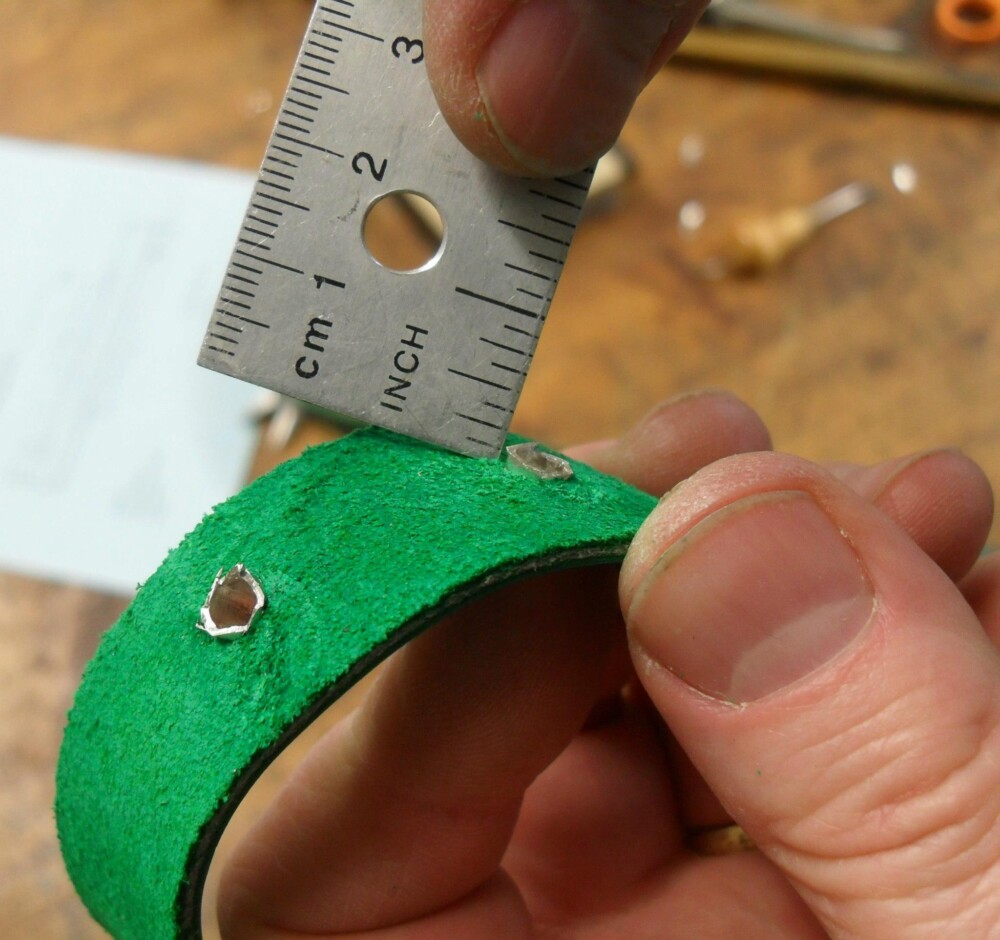
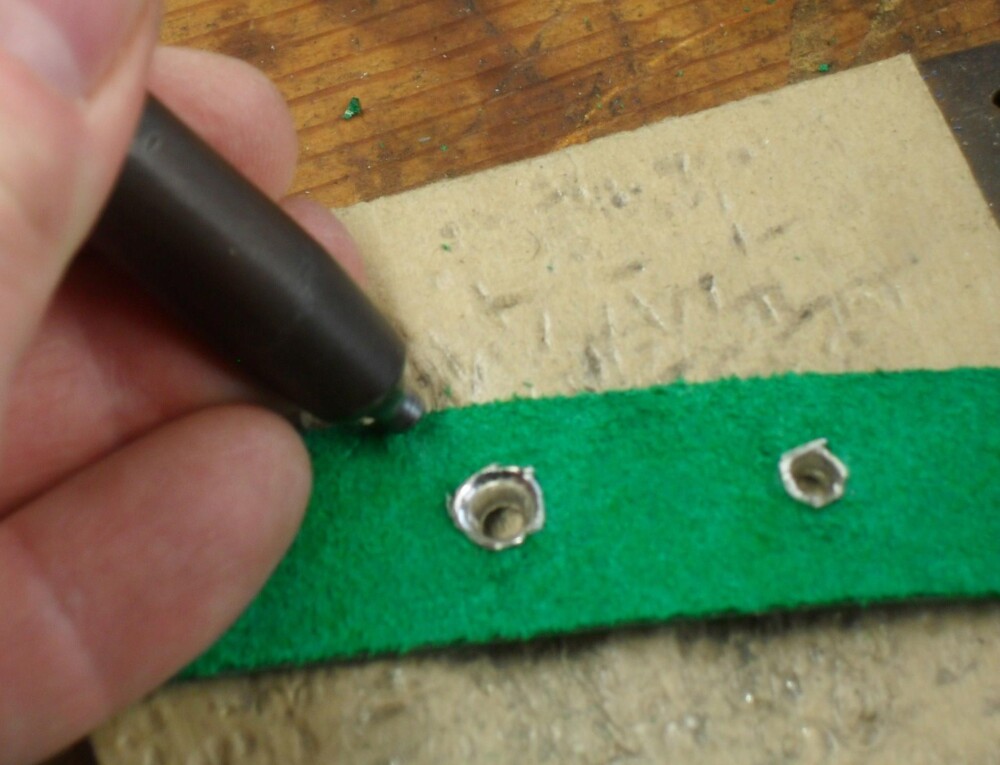
Very little of the tube should protrude after trimming.
We use a rivet setter to open the eyelet tube and spread it out. You can substitute any rounded steel object that you can hold and tap with a hammer. We have used the ball of a ball peen hammer driven with a leather mallet, and even a center punch. You really just need to get the top of the tube starting to spread open.
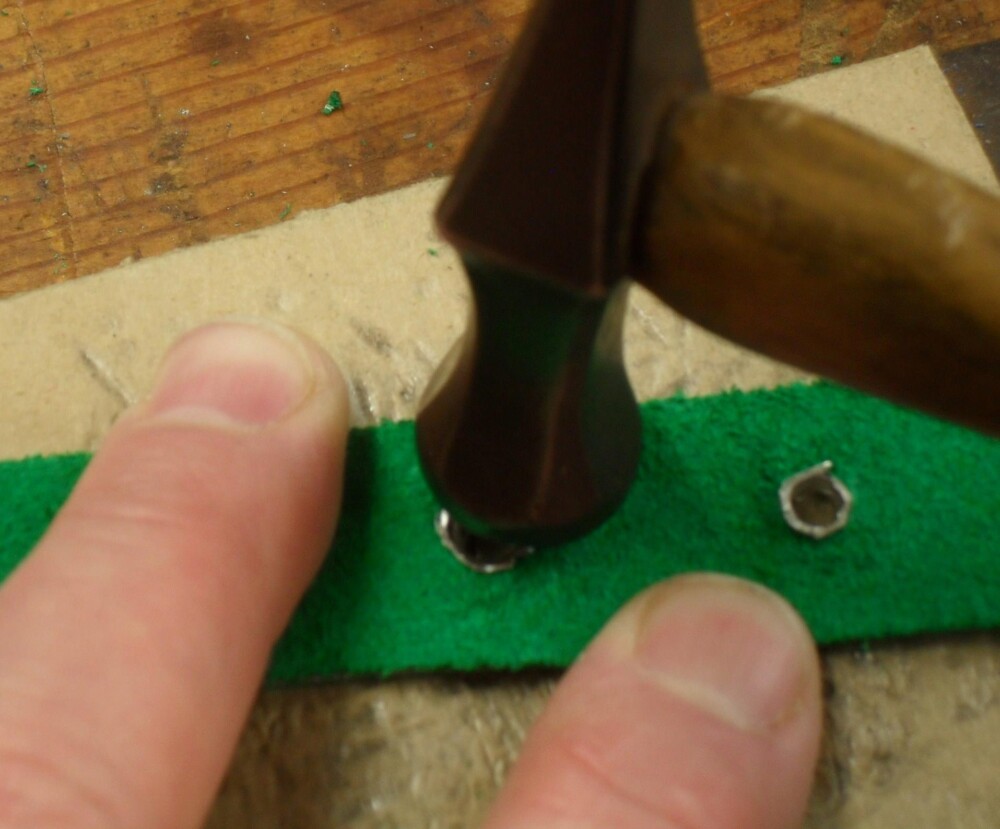
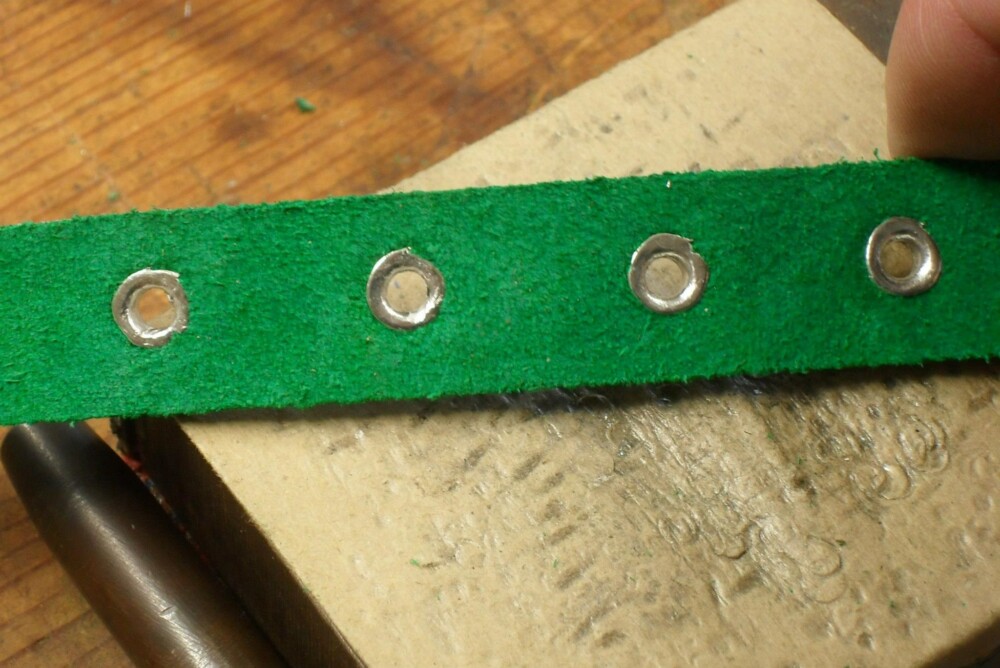
Finish spreading and smoothing the eyelet tube with the flat face of a small hammer.
These eyelets are finished. Because we spread them without grinding them level, some of the rivet tubes split on the back. As long as the tube itself does not split these will function perfectly. You do want to make sure all the edges are pressed down into the leather and that they will not catch on the wearer’s clothing.
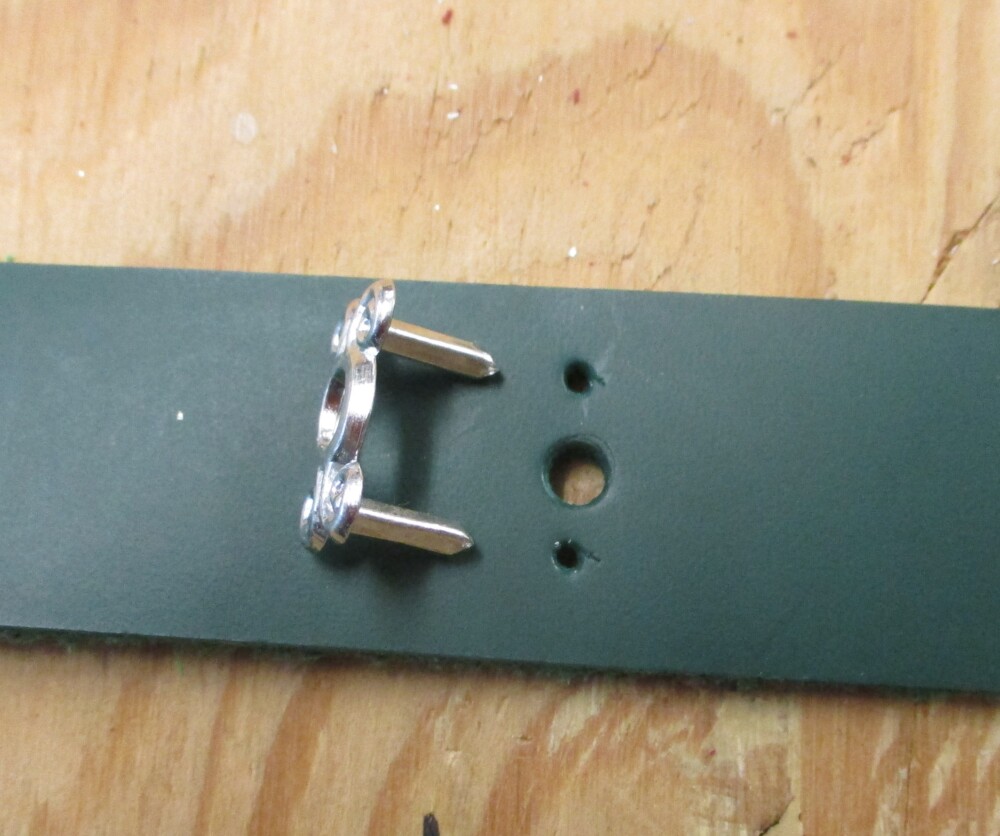
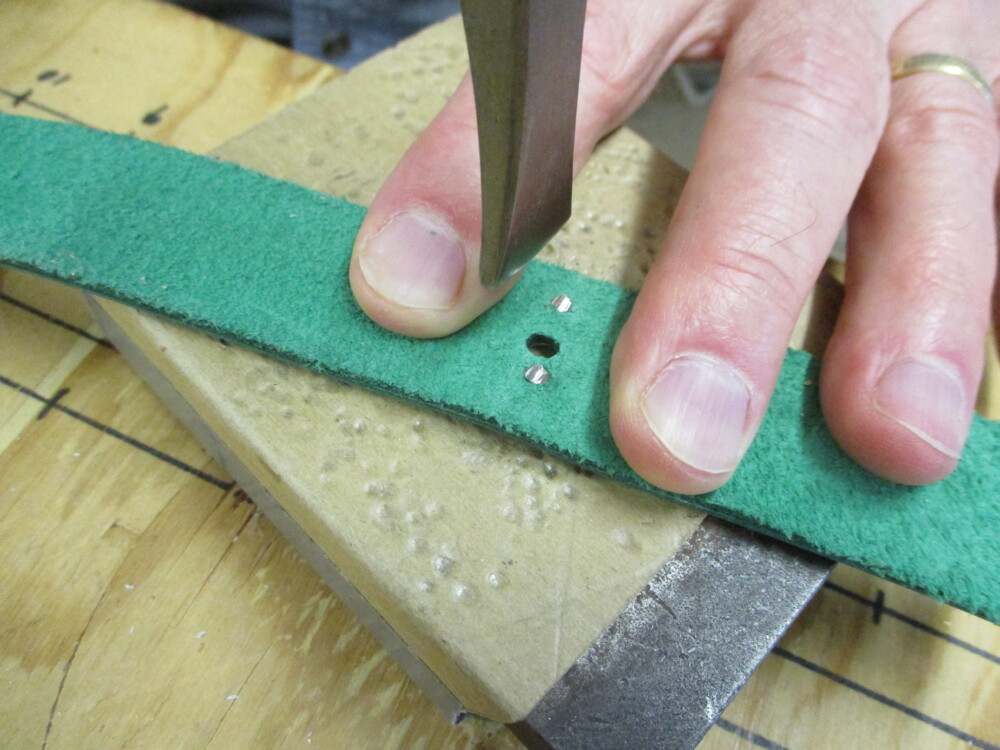
We also have eyelets that sit on the surface of the belt and which are attached with integral pins. Punch the central hole and the pin locations.
Put the pins through, cut them off close, and peen them up like rivets or mounts, being sure to spread out the metal on the back.
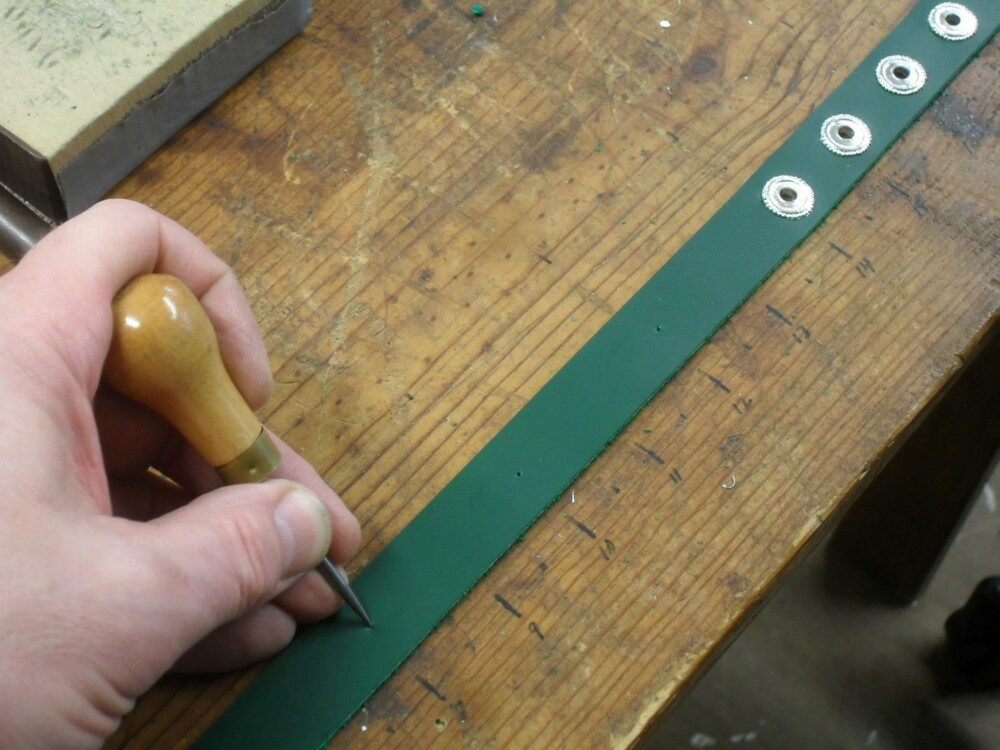
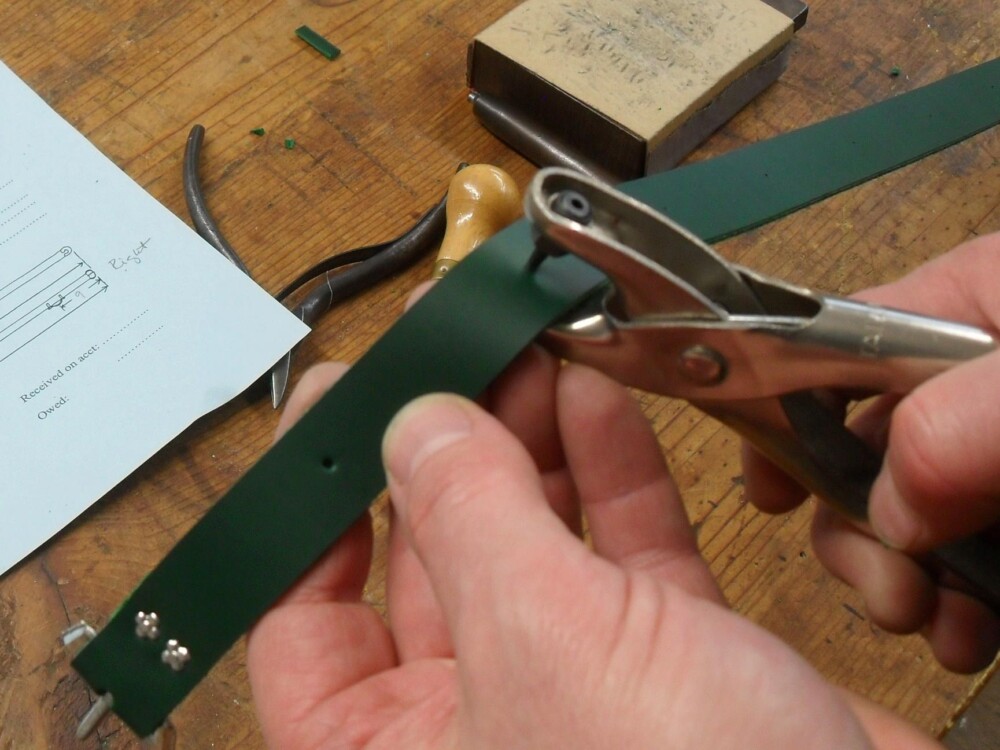
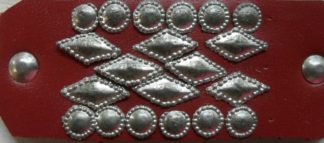
Marking the spacing for studs. Extant straps from the Middle Ages we have seen show spacings ranging from 3/4 of an inch to 3 or 4 inches (2 to10 cm) apart. It is a matter of taste – although as sellers of pewter we prefer to see them closely set. 😊 In any case, choose an easy-to-measure distance and apply it to the entire belt. (Do not guess how many studs you will need, then try to space them evenly. This is a disaster waiting to happen.)
As with the rivets or the buckle, the holes for the studs should be the smallest you can force the pin of the stud through. Use your smallest leather punch or an awl.
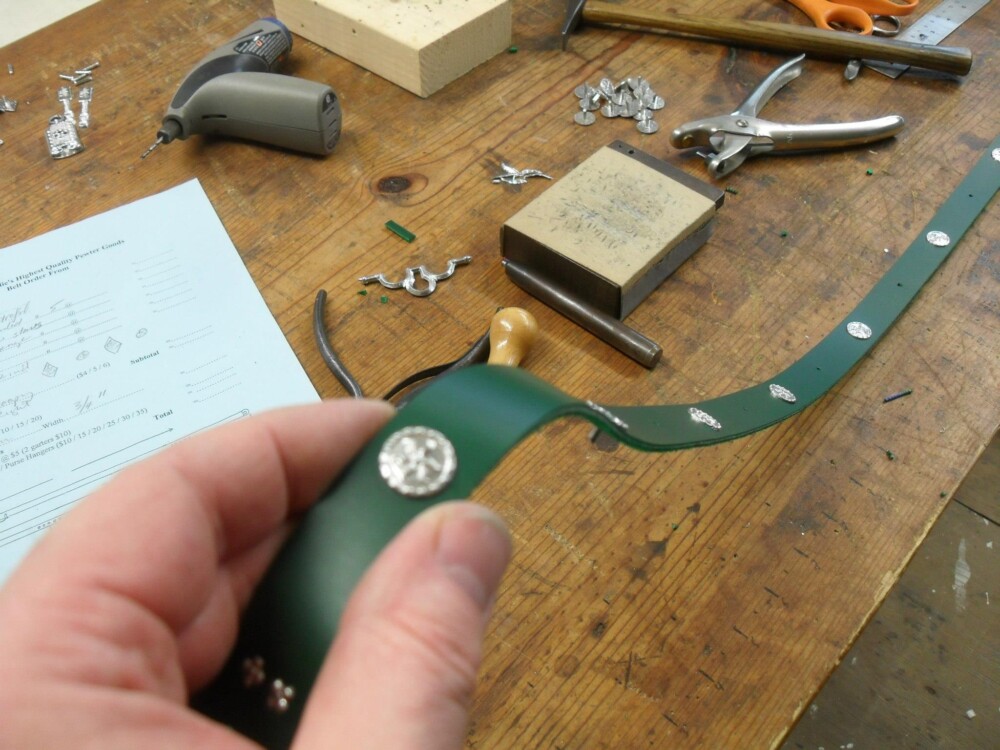
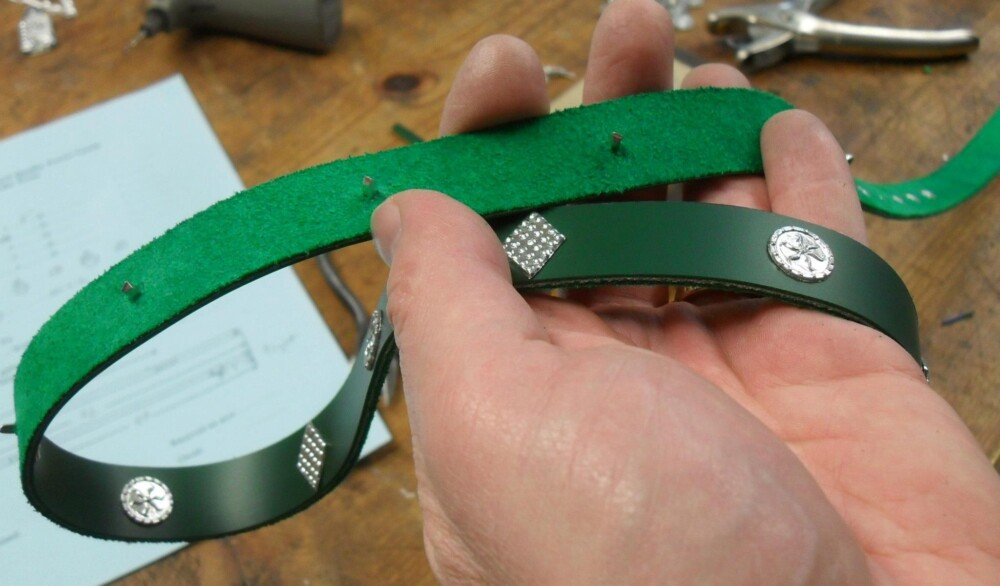
This belt has alternating studs. Sad experience has taught us to put all the studs of one sort in, leaving holes for the other, and check it over carefully…
before plugging in the second style of stud.
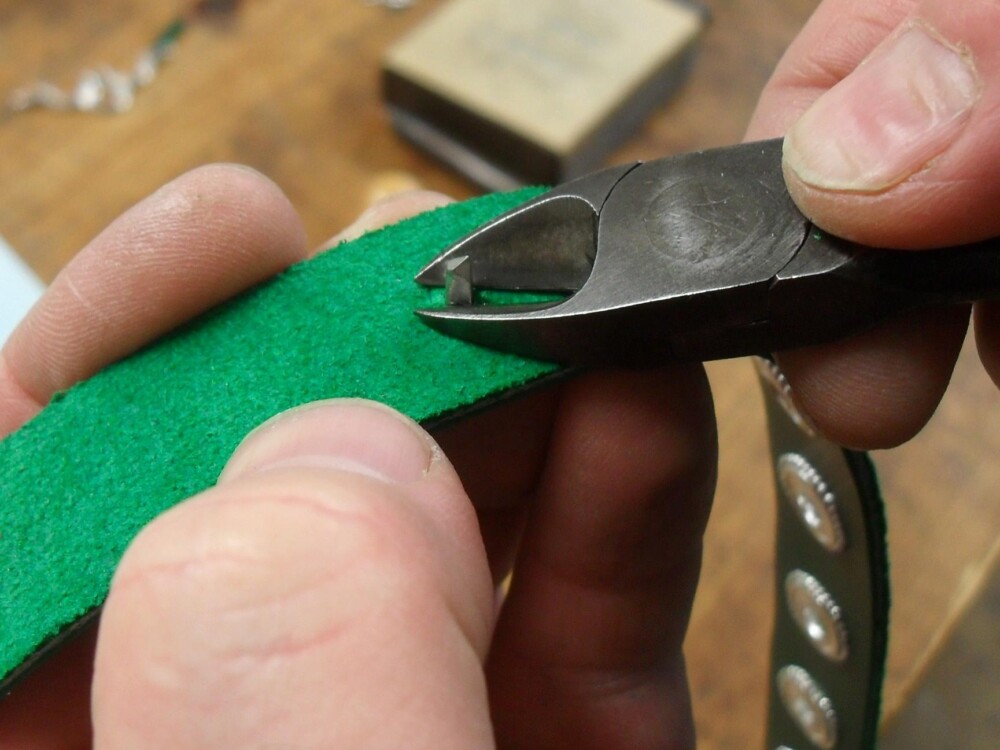
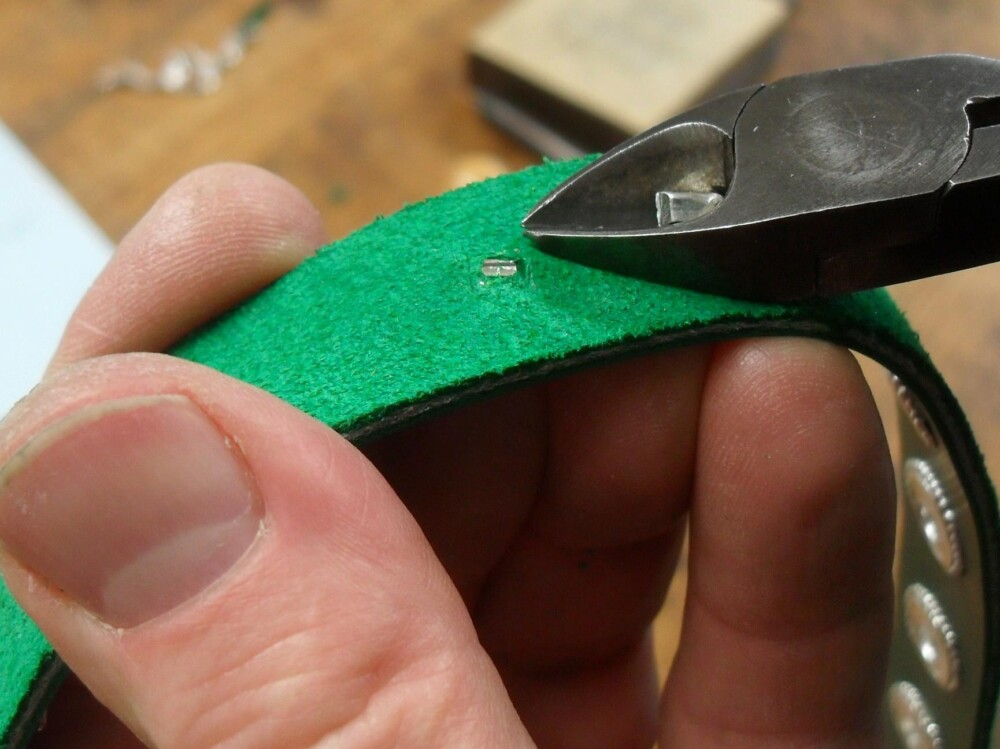
Nip the stud off pretty close – The stud shank/pin that remains should be no taller than its own diameter.
Very little is left proud of the surface…..
… just enough to spread out cleanly as you set the stud with a small cross peen hammer, riveting as always against an anvil covered with a thin sheet of cardboard. There is no need for washers; a carefully spread out stud shank will keep the decorative piece in place through normal use. Did I mention our blog post, Getting Crafty with Billy and Charlie: Belt Studs?
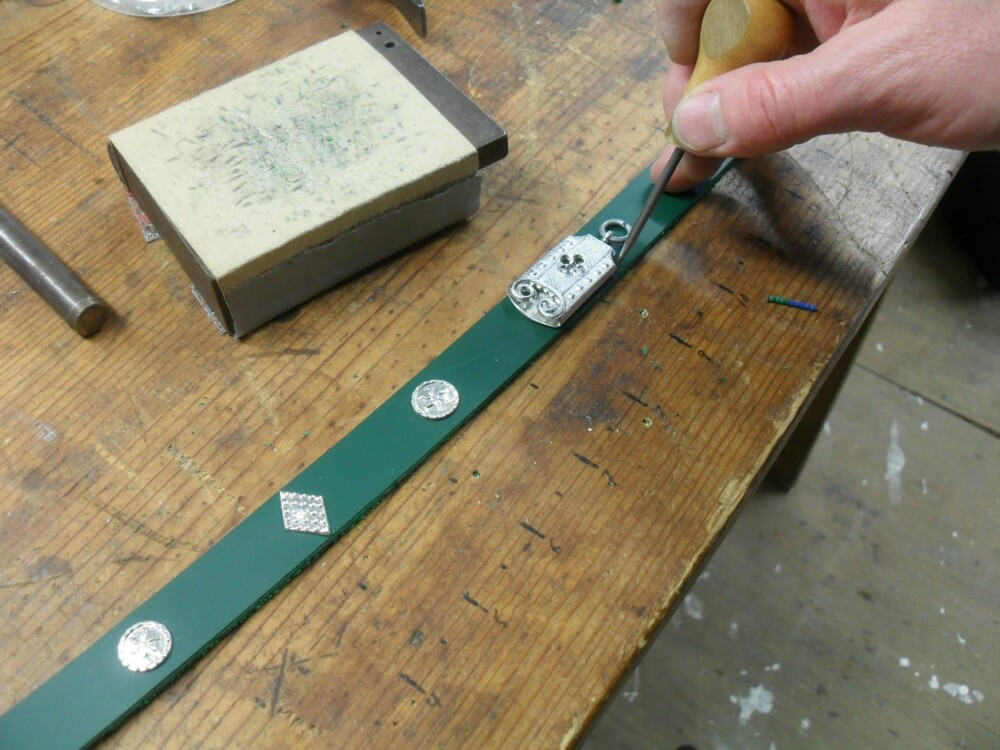
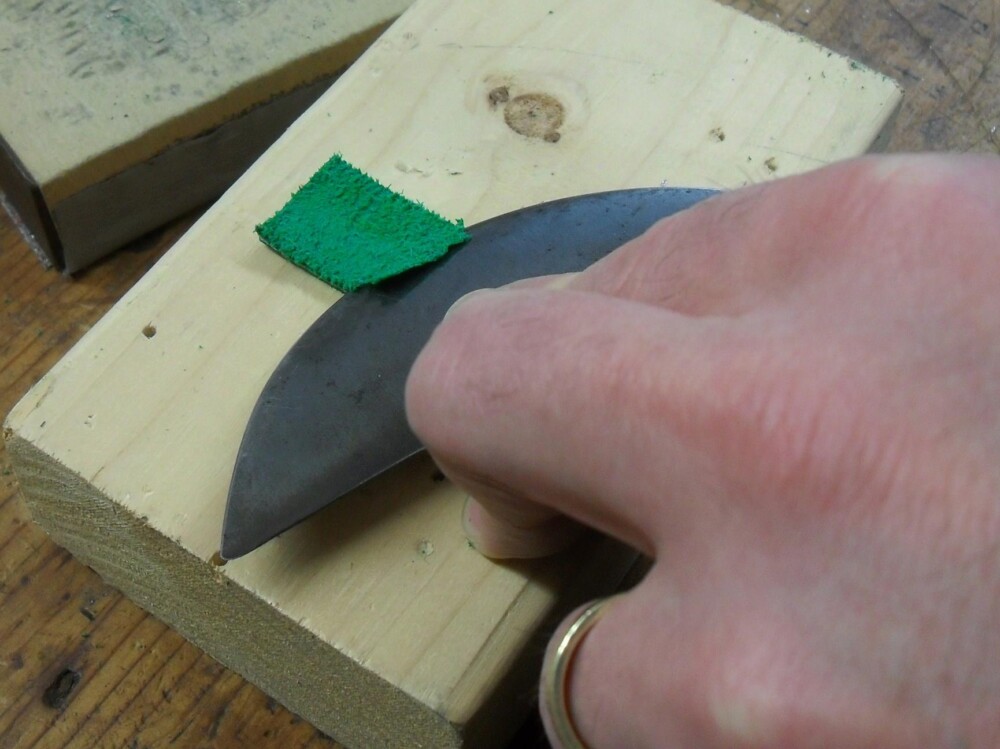
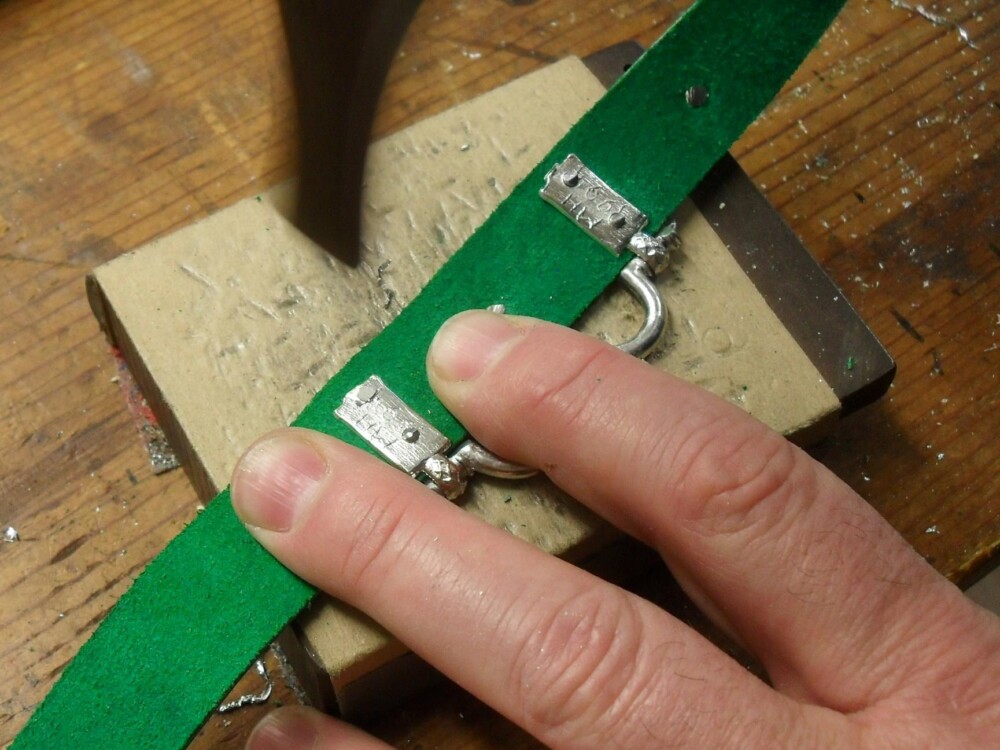
Figure out where the end of the chape will go; mark the leather, then cut off the excess.
Thinning the end of the strap lets it fit snugly into the socket of the chape.
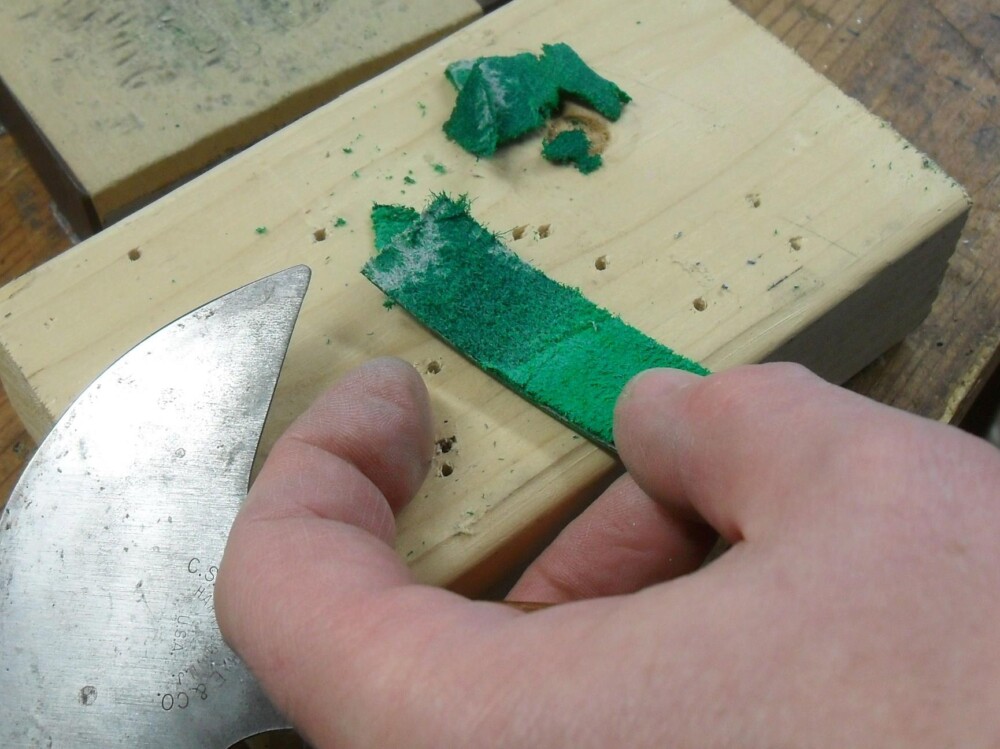
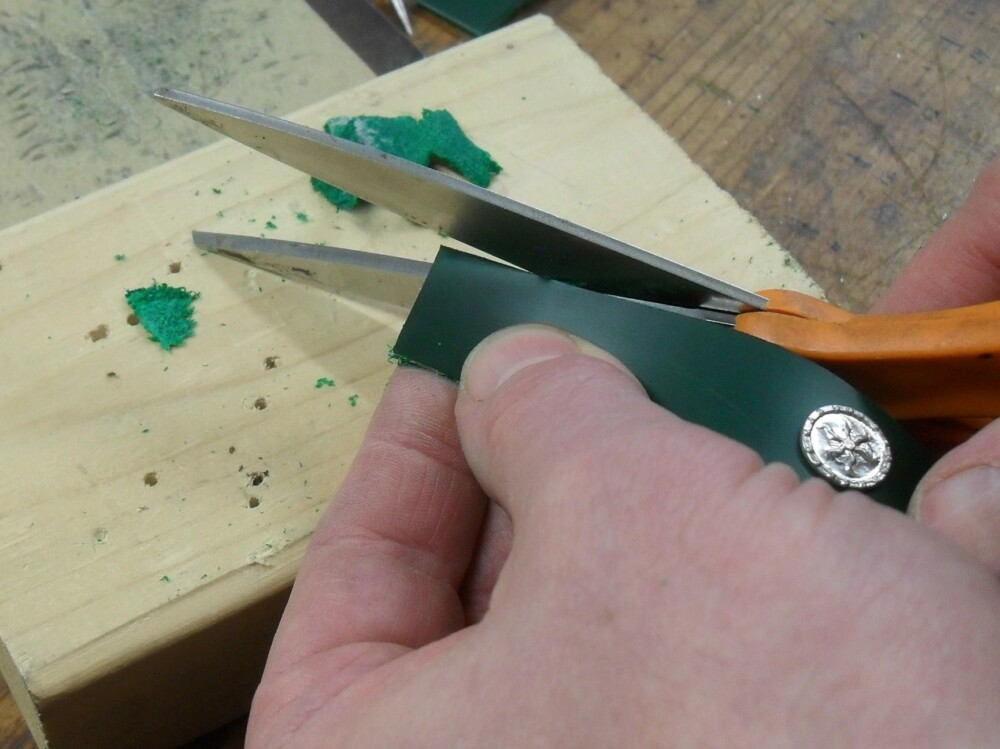
If you do not have a head knife, you can use other tools to skive down the thickness. We have used an X-acto knife, a Skife razor blade skiving tool, a leather splitter, and a grinder. Practice on a scrap piece first.
Trim the edges to a slight taper…
… that fits exactly into the chape.
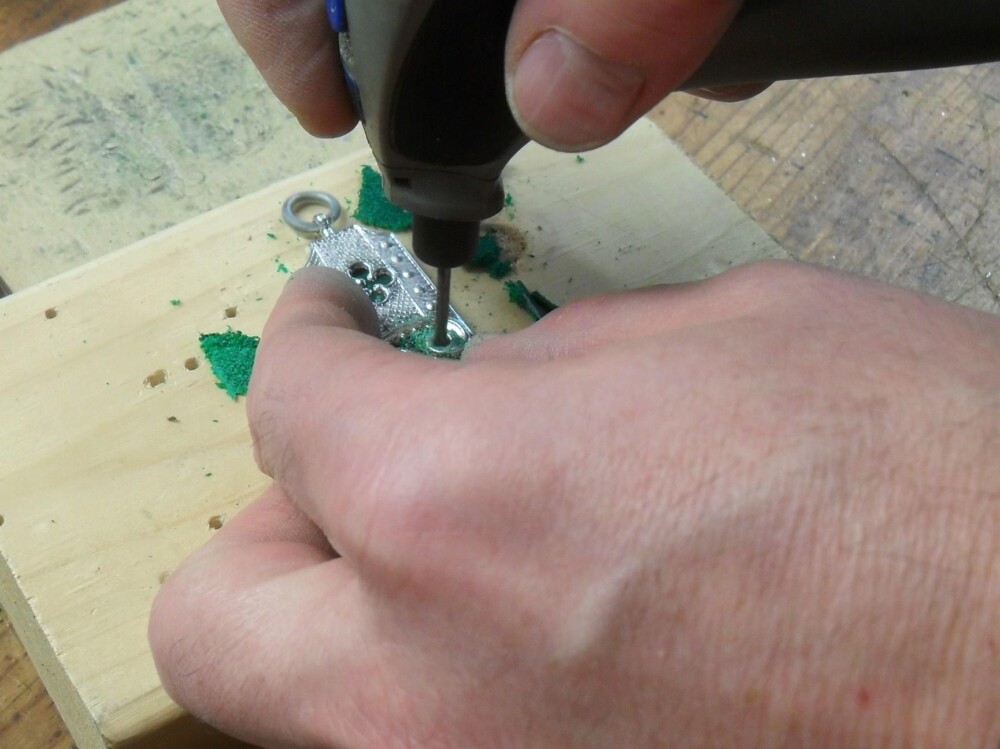
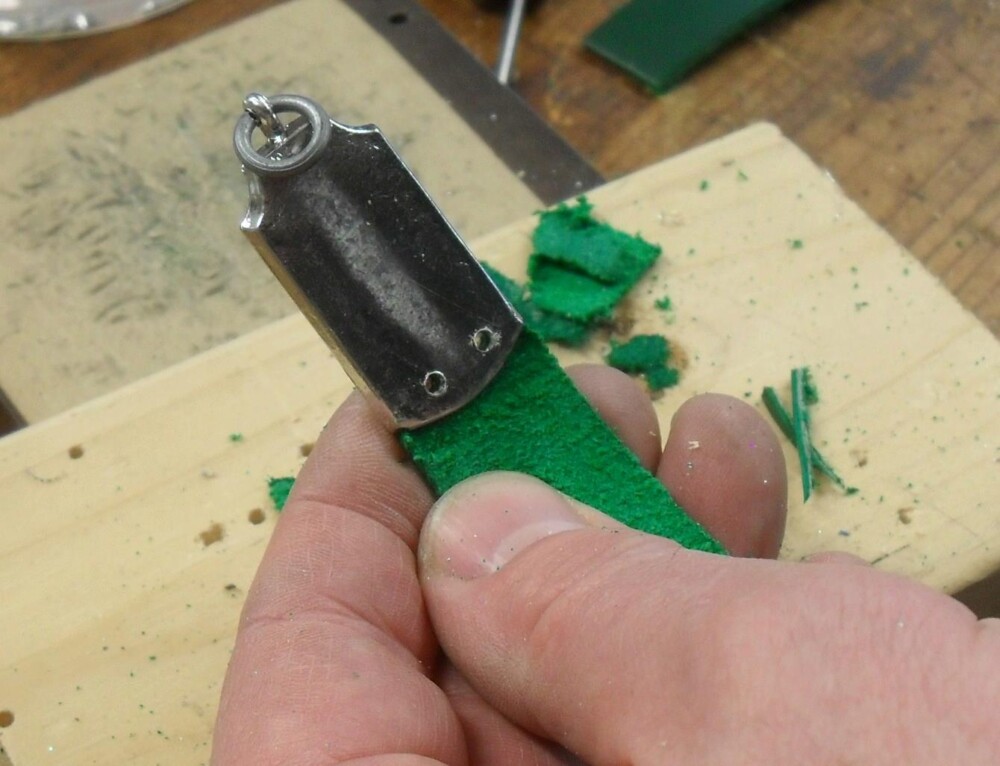
Drill straight through the leather and the chape together. Our rivets fit in holes drilled with a 3/32″ (2.4 mm) drill bit. We drill into a piece of scrap wood.
If you drill though the “sandwich” of pewter and leather, your holes are certain to line up.
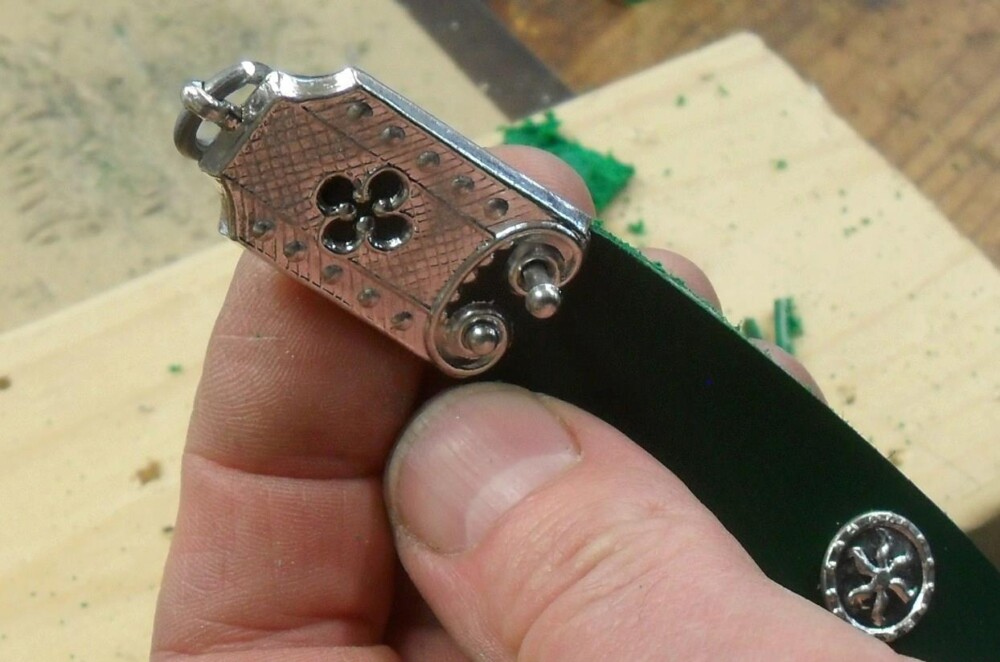
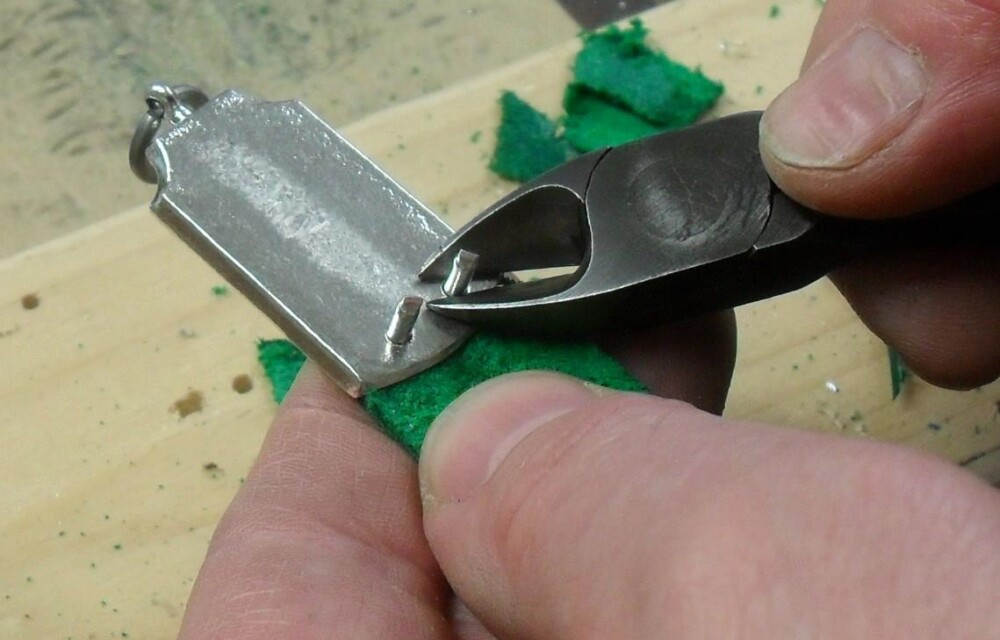
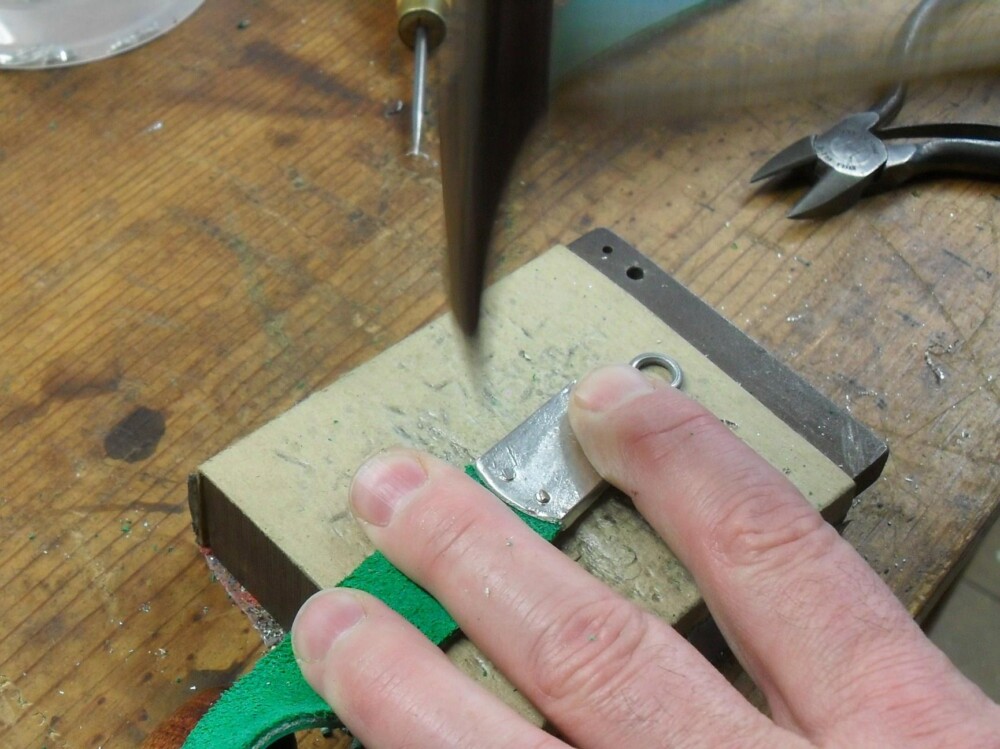
Press the rivets into the holes.
As before, nip them off close.
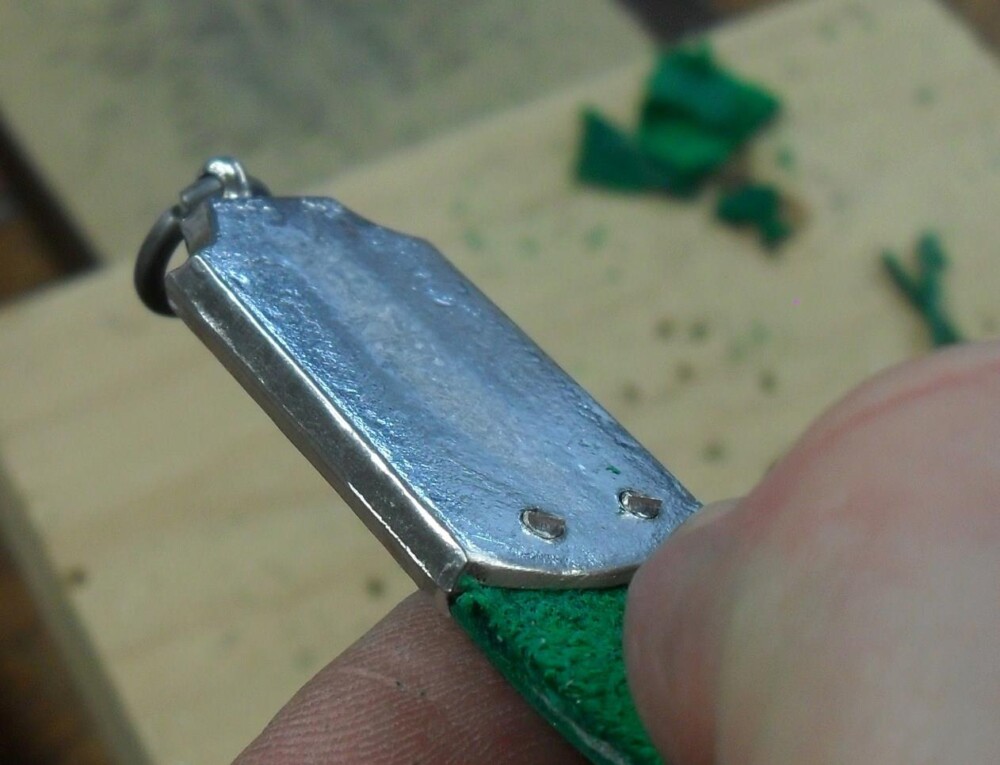
Really close.
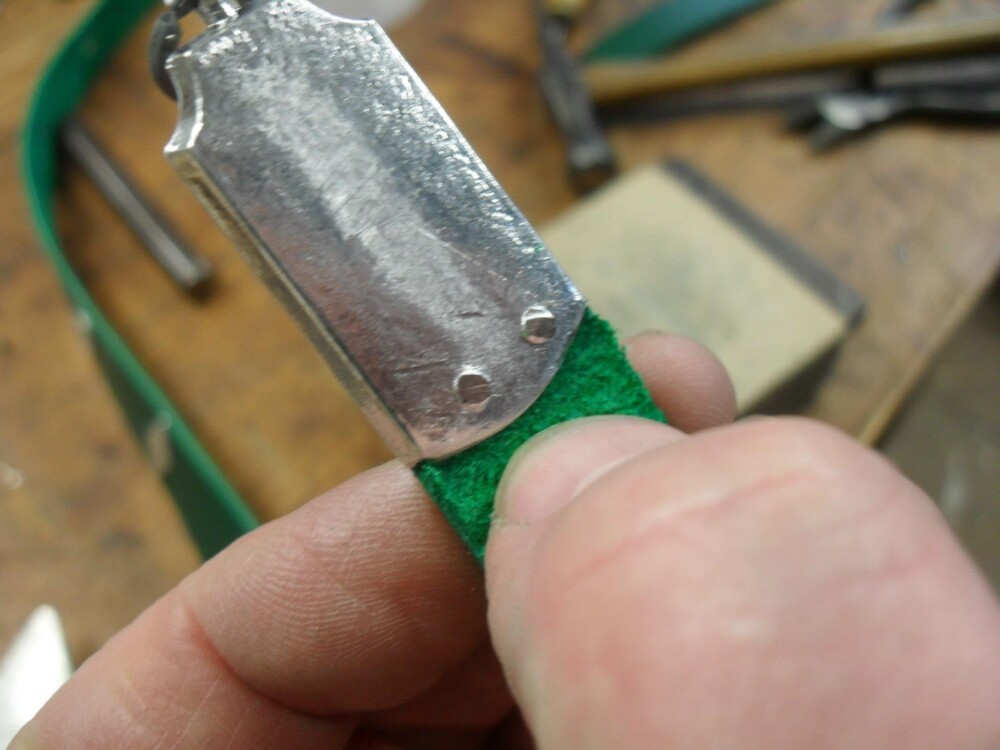
In this case the back of the chape serves the same function as the washers did when attaching the buckle – they give you something to peen the rivet up against and keep it in place.
The rivets are secure. Give them a final tap with the larger face of the hammer to make the back of the chape nice and smooth.
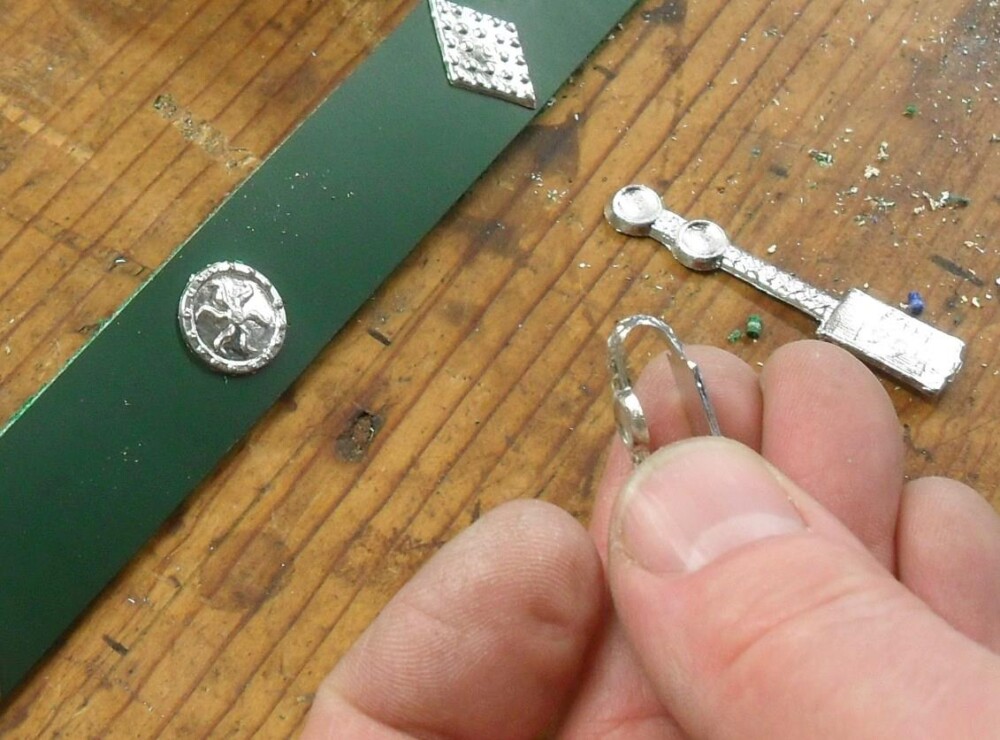
To attach a purse hanger, start by folding the hanger pieces.
Slip one over each end of the hanger.
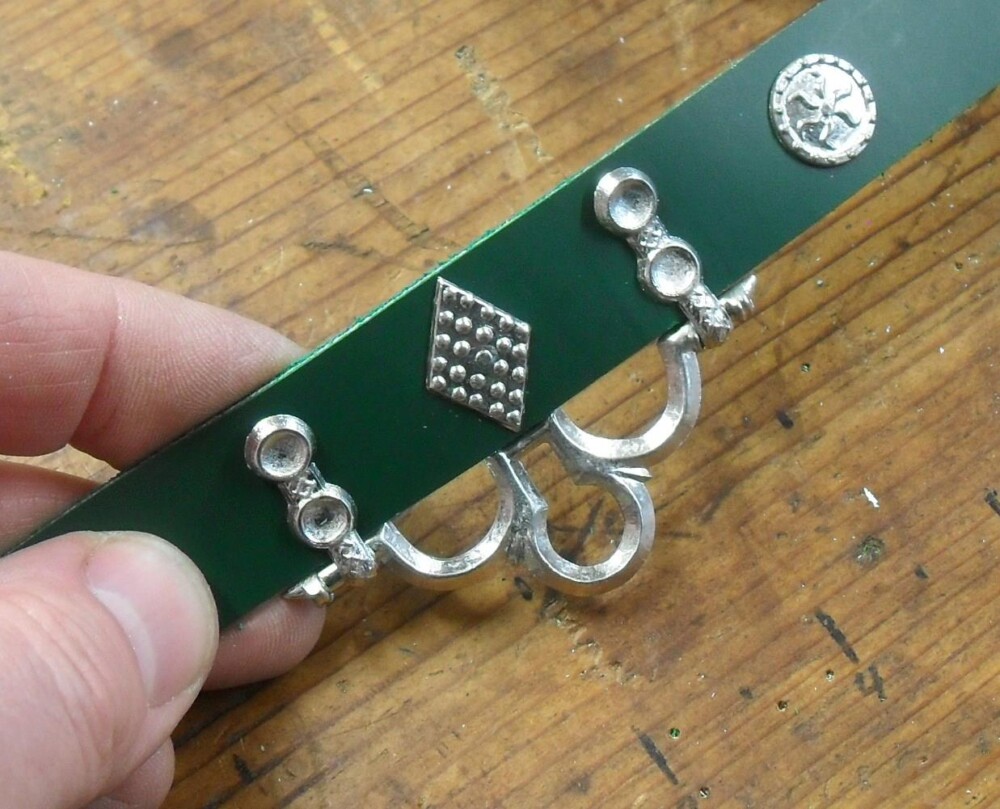
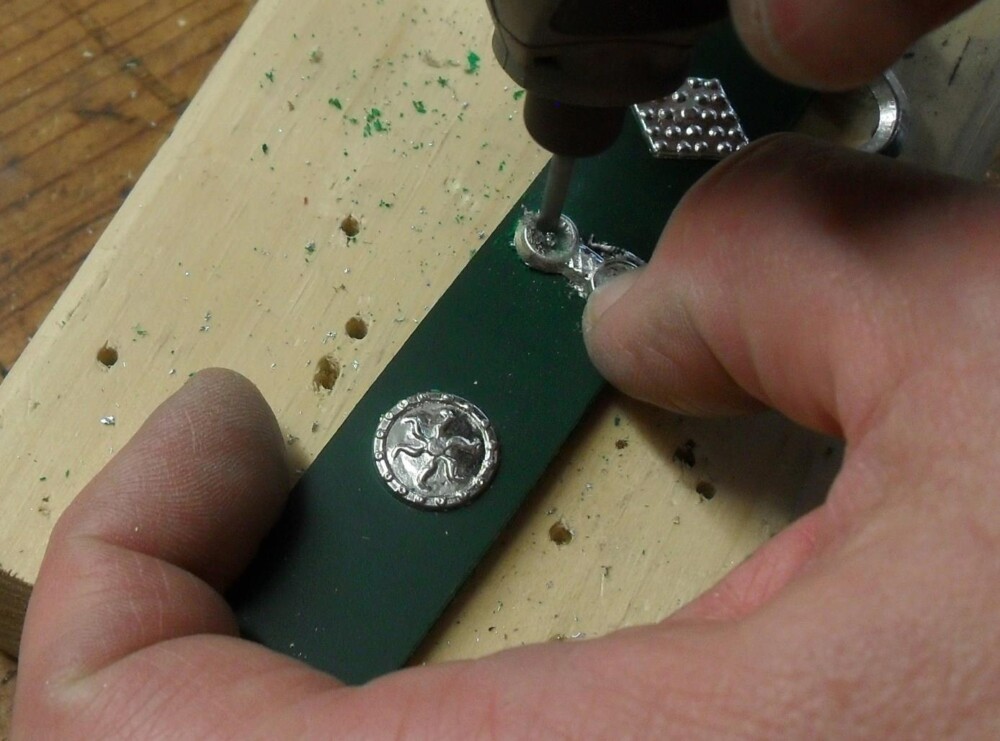
Depending on your stud spacing and your layout, the hanger may fit around one stud or replace two.
We’ve said this before: drill straight through, leather, pewter, and all, to keep all the pieces aligned.
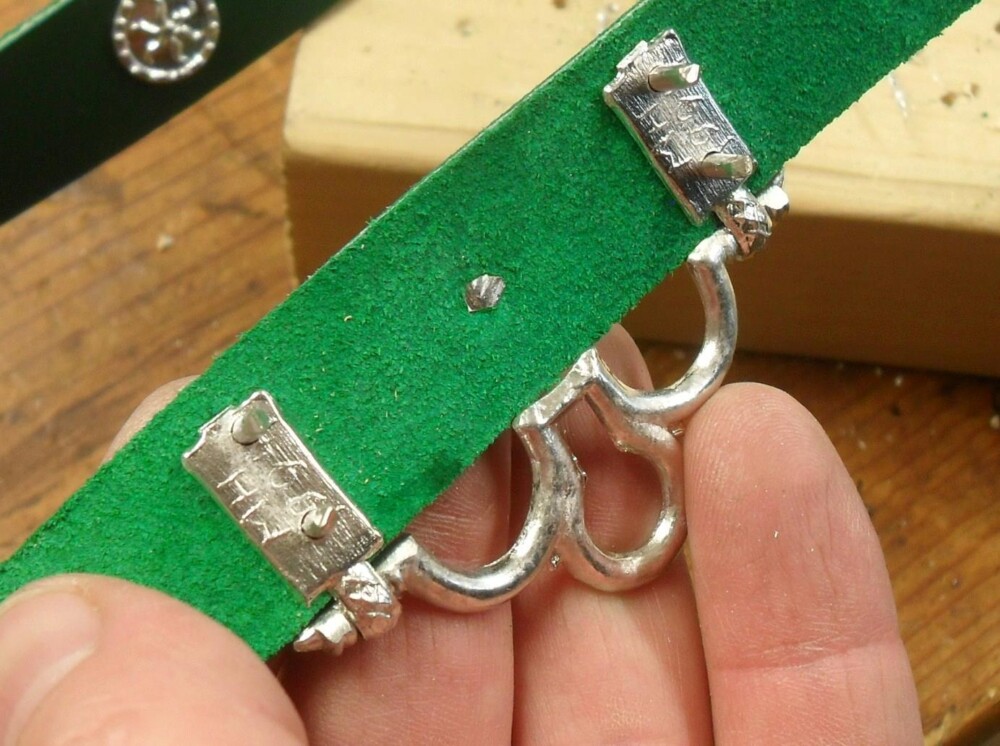
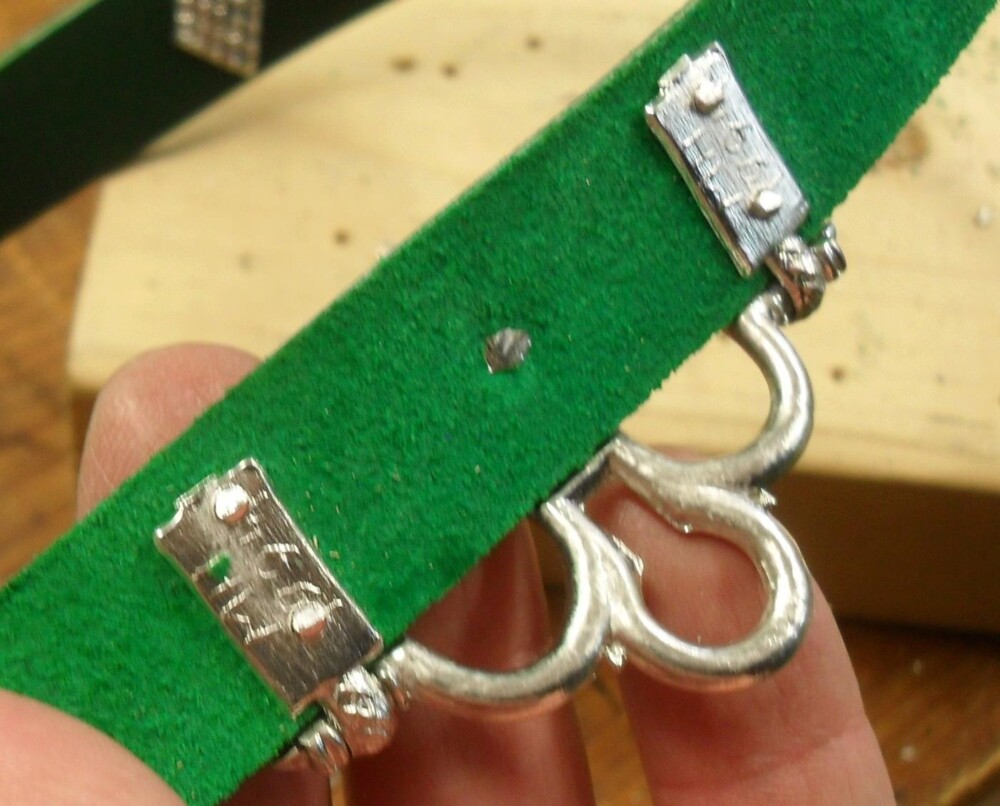
The rivets go through….
… are nipped close ….
…. and peened up. To learn more about this process, see our blog post Attaching a Purse Hanger. It covers the same information, but with more words and more and different photos.
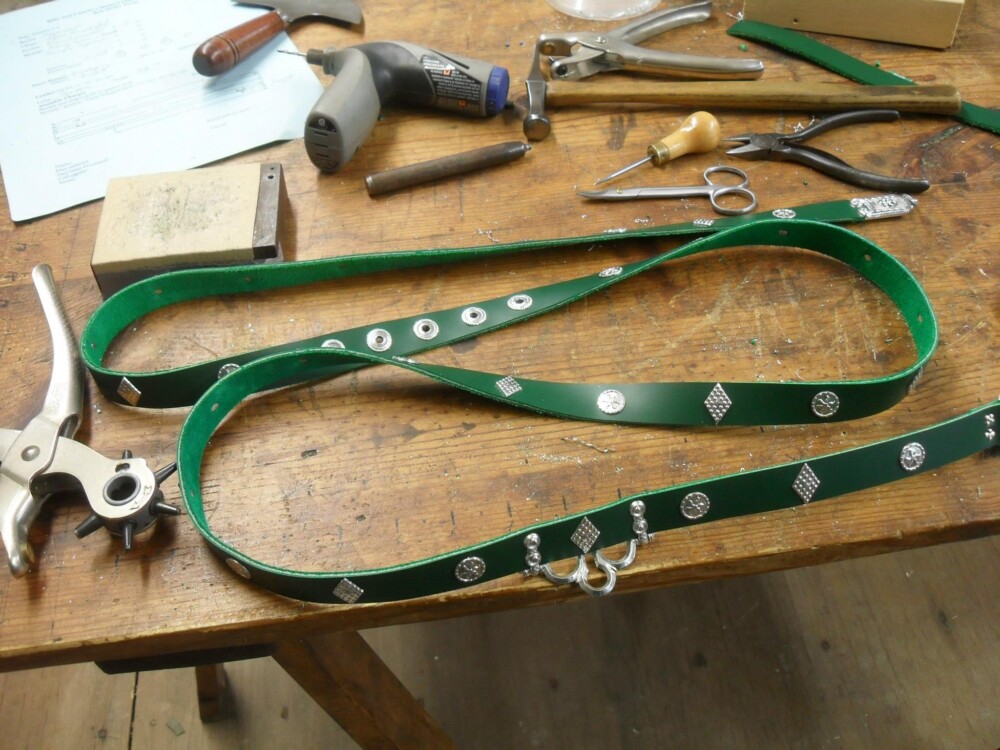
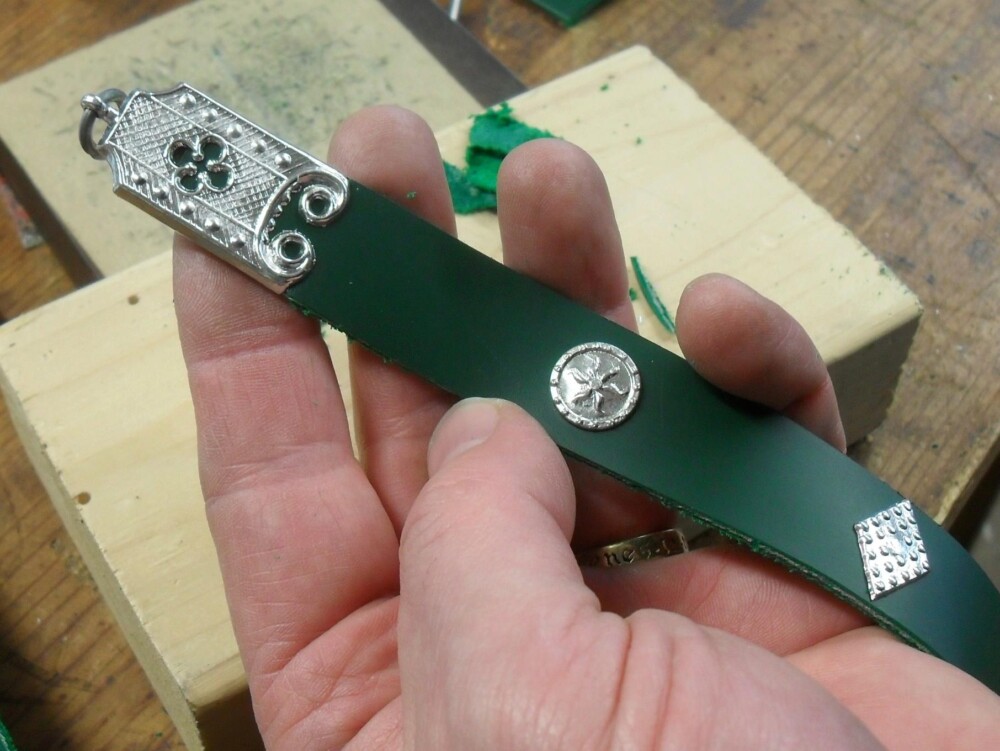
The finished belt!

Would you like a shorter version of this information with no photos? See Putting Together a Belt with Pieces from Billy and Charlie.
Posted on Leave a comment

Turning the Rotterdam Box

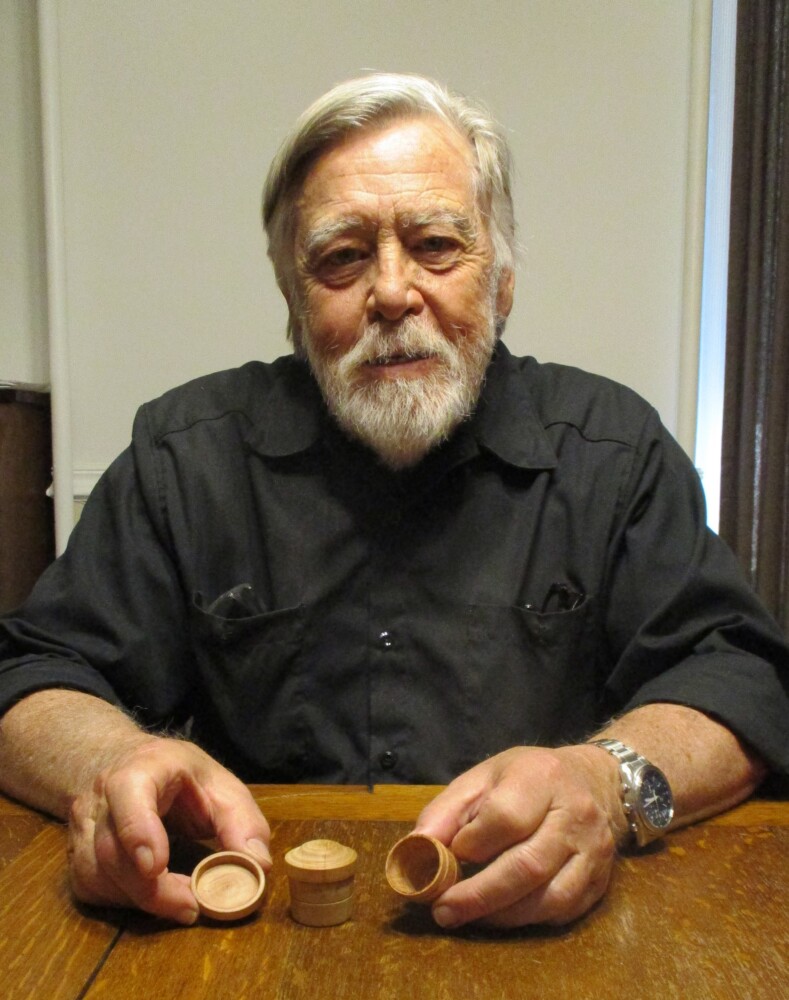
Our friend Chuck (Master Gryphon), a talented wood worker, has been working on making replicas of the turned wooden box in which the three Rotterdam brooches were found. He has shared a step by step description of his process.


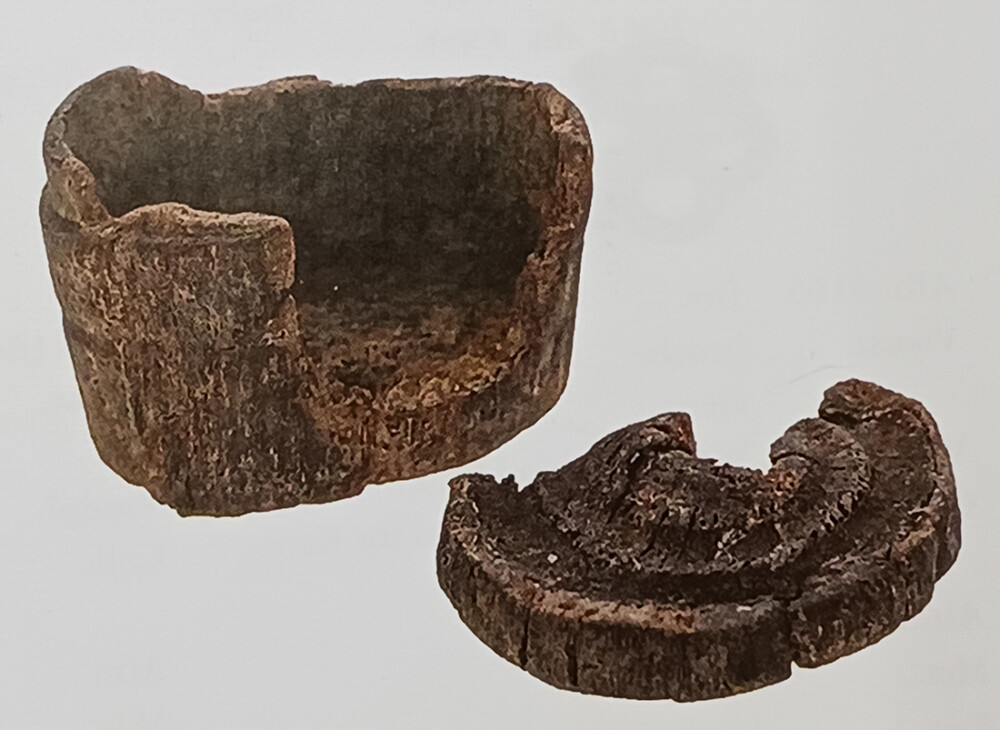
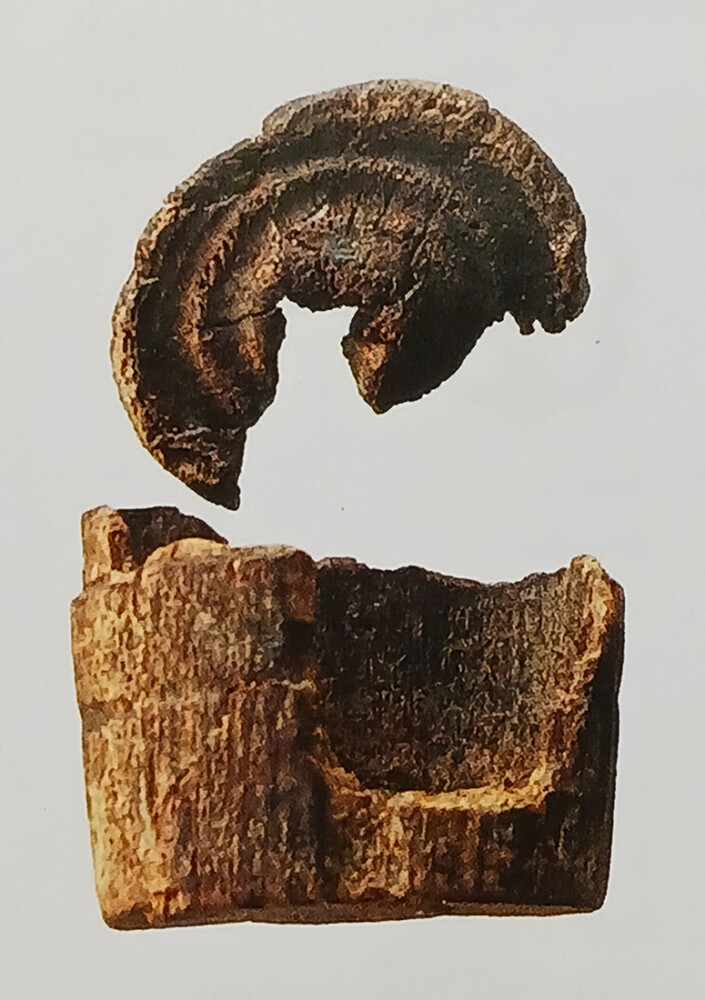
The Rotterdam trio, as we call them, are three brooches dated to 1350-1400. They were excavated from the construction site of the Markthal in 2009-1010 and when they were found, they were all in a single wooden box, barely large enough to hold them. Images of the brooches and the remains of the box were published in Heilig en Profaan 3 (2012).

The kind folks at Archeologie Rotterdam (BOOR) provided better photos of the box (as well as images of the three brooches). They say that the wooden box is 2.7 cm high and approximately 3.0 cm in diameter.

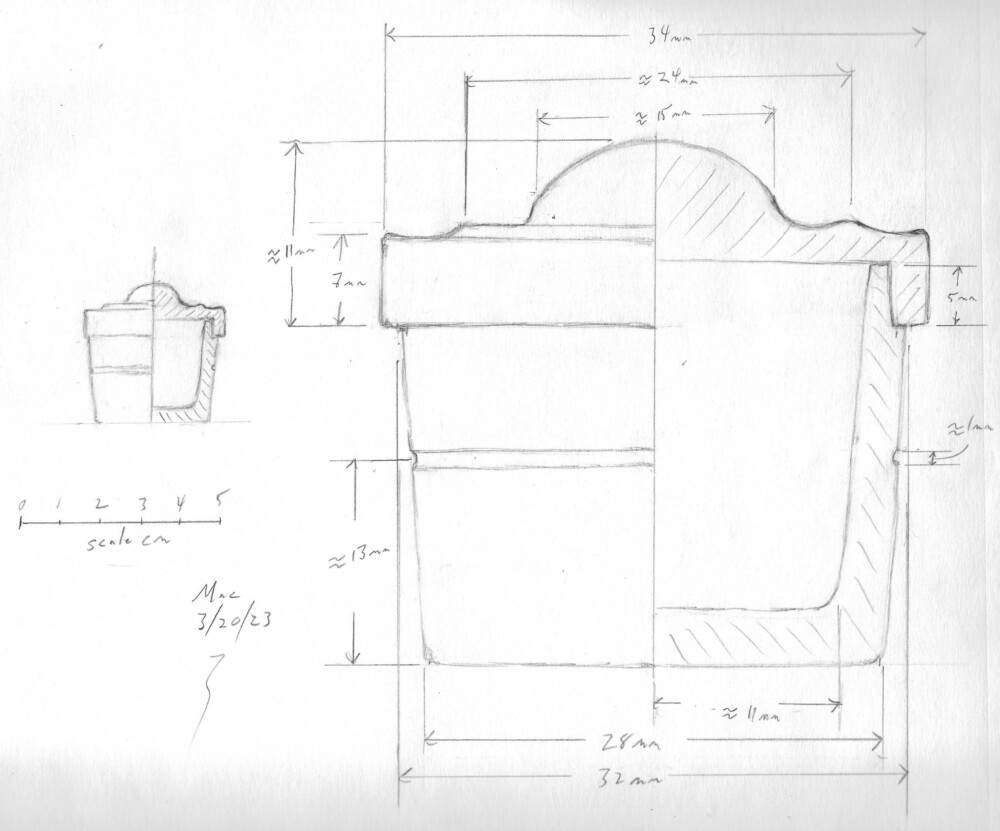
Chuck and Mac studied the photos, discussed where the measurements were taken, and talked about what the box might have looked like when it was complete. Mac made a sketch showing the results of their analysis.
After a series of experiments and test pieces, Chuck produced not only our box (and some additional boxes for friends), but also photos showing his procedure. He has been kind enough to share these:

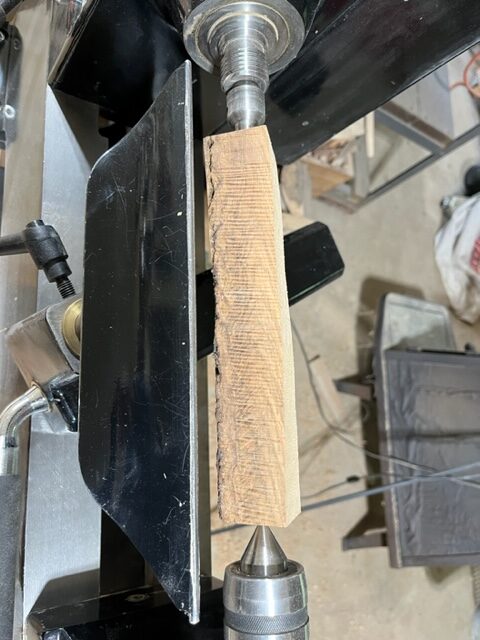
Select a square piece of close grained hardwood at least 1.5” square x 6” long. Mount between centers on the lathe.

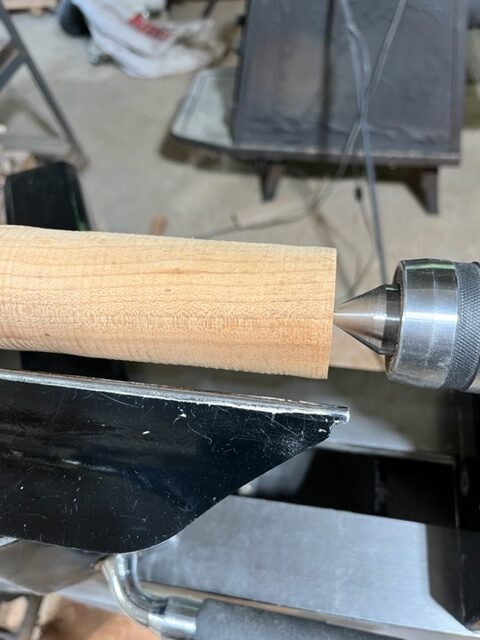
Turn round to just less than 1.5” diameter.

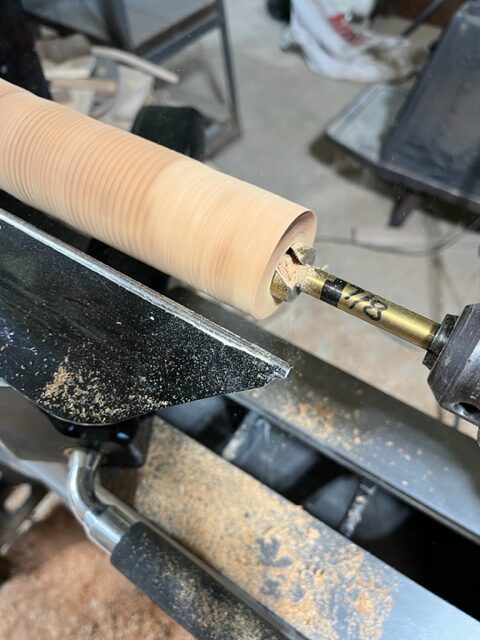
Use a 7/8” Forstner bit and drill in 21mm. Can also use bowl gouge or scraper instead of drill.

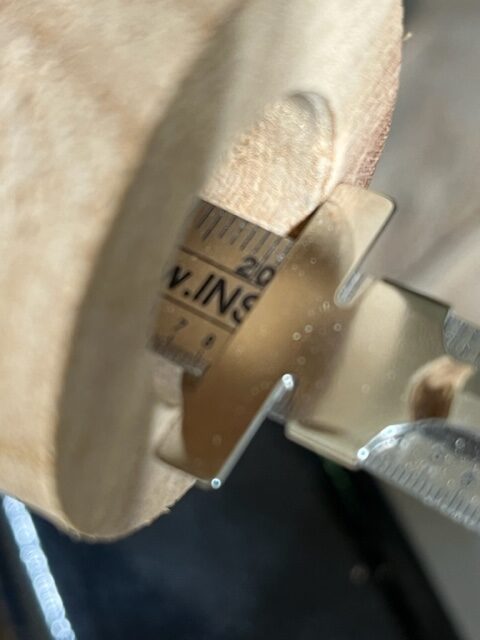
Check the depth for 21mm.

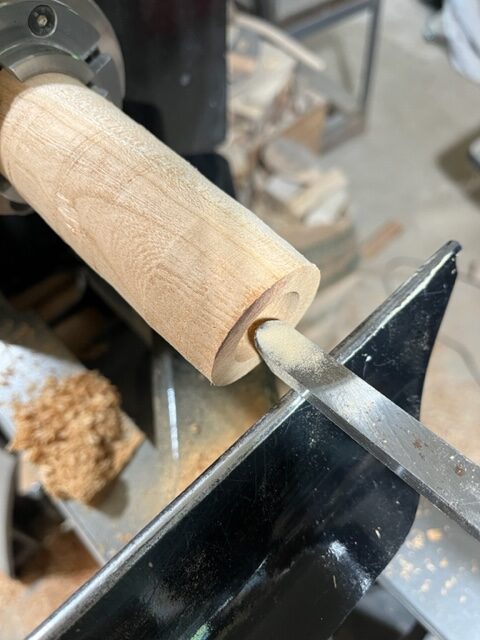
Use a round nose scraper (or bowl gouge) to shape the inside to the proper dimensions and taper (26mm at top and 22mm at bottom).

Place live center in opening.

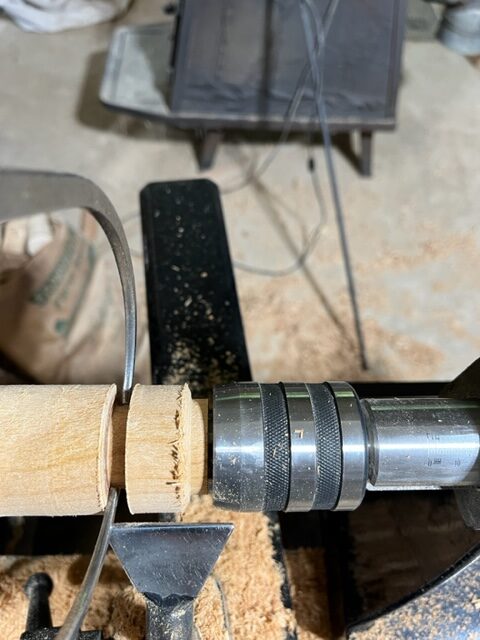
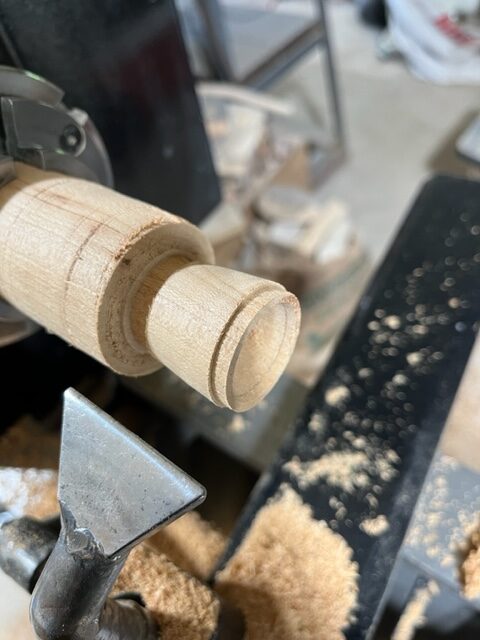
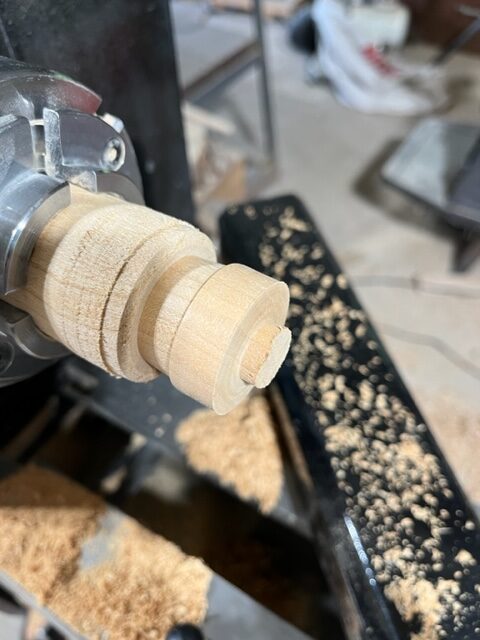
Use spindle gouge to turn the outside to the proper dimensions, taper, and add lip for lid.

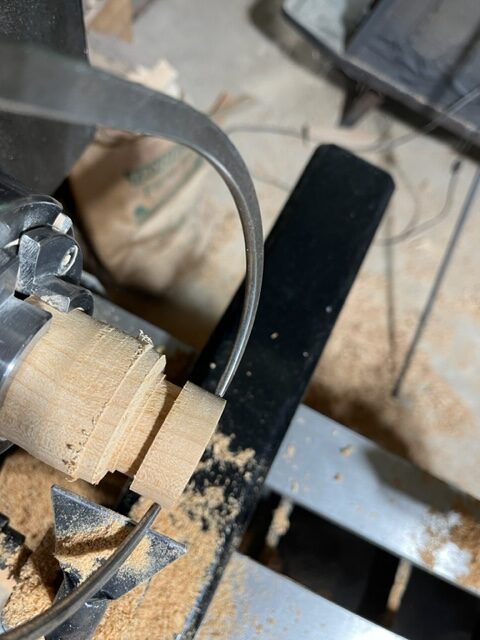
Use parting tool to cut to length leaving it still attached. Sand the inside and outside and finish parting from lathe.

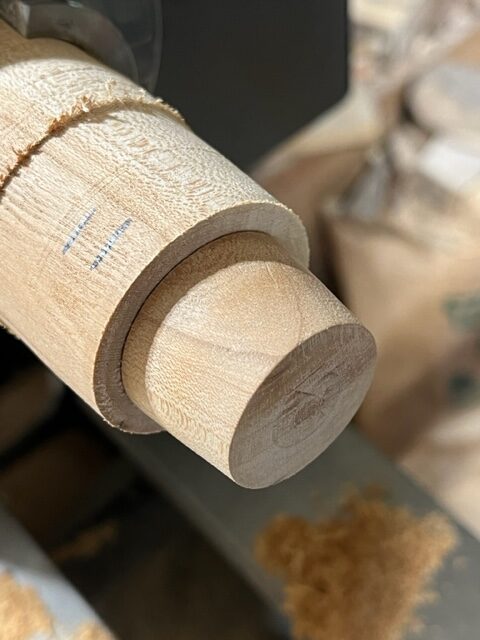
Mark the remaining piece on the lathe for the top dimensions (7mm and 11mm) and turn the inside to match the lip on the bottom.

Insert the bottom into the top recess and check for tight fit.

Turn the top diameter to 34mm diameter and 11mm long.

Sand and part the top from the lathe.

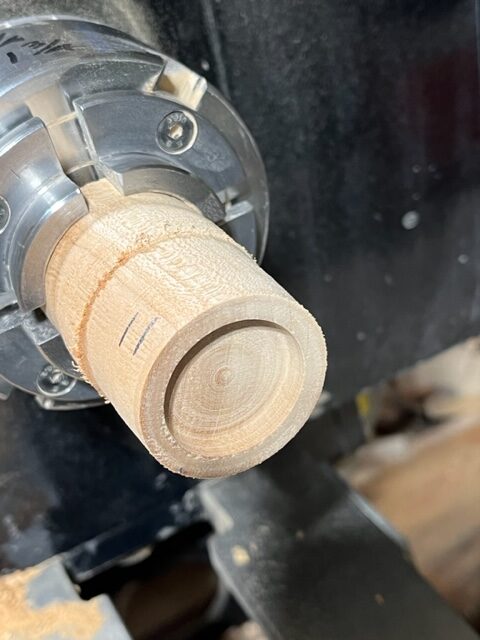
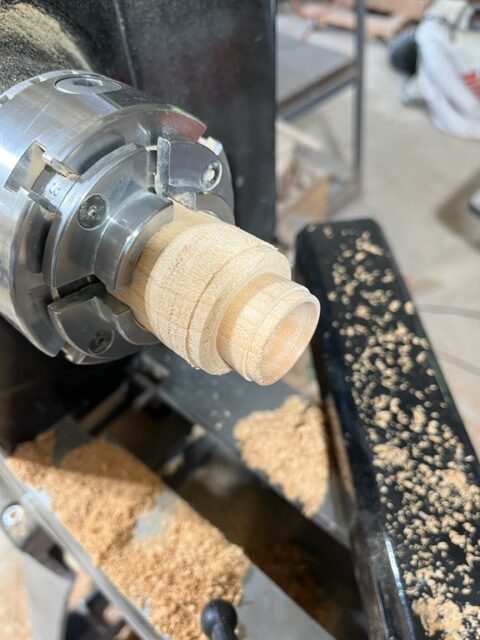
Turn a recess into the remaining piece on the lathe to accept the bottom and act as a jam chuck. Check that the bottom is centered.

Mount the top onto the bottom.

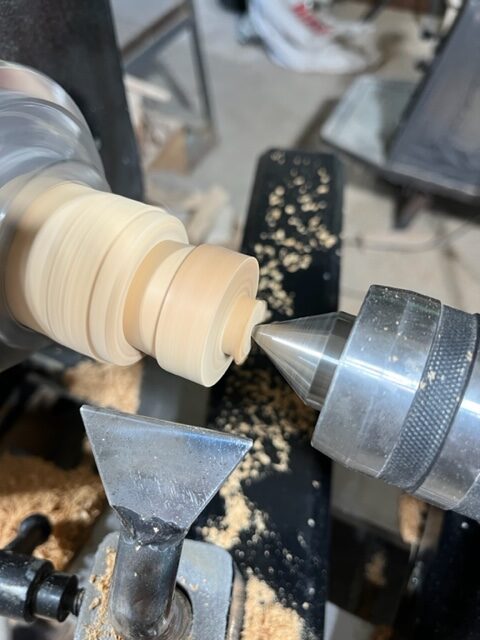
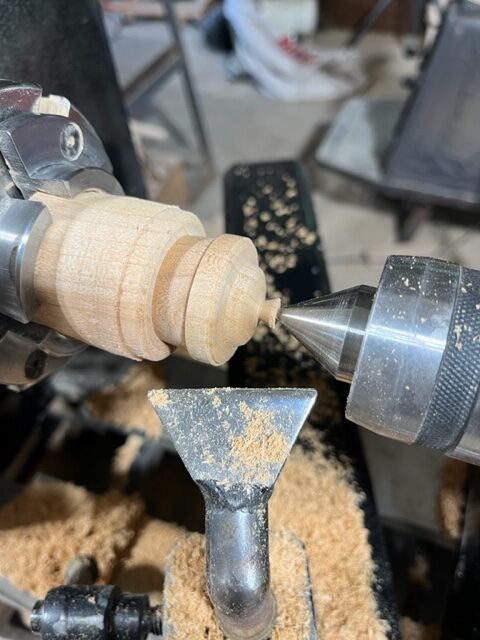
Adjust the tail stock to lightly support the top mounted to the base.

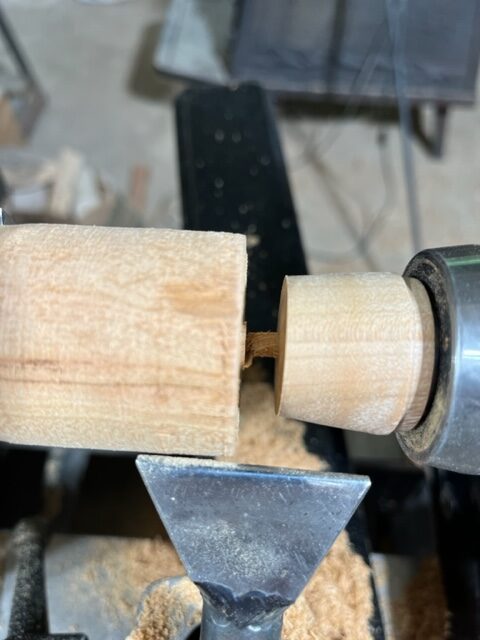
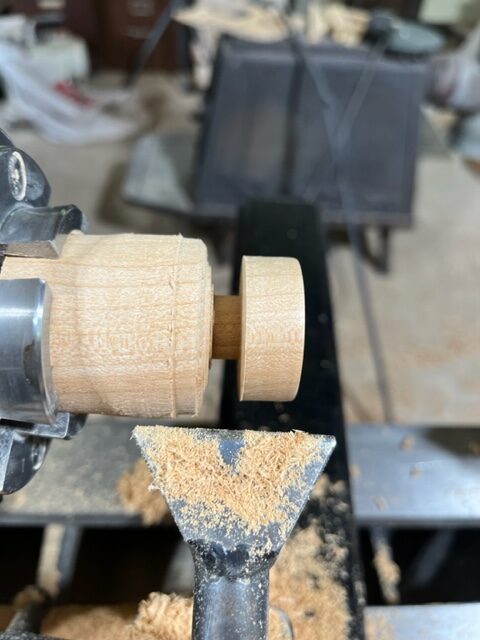
Finish turning the outside of the top. Remove the small stud and sand.

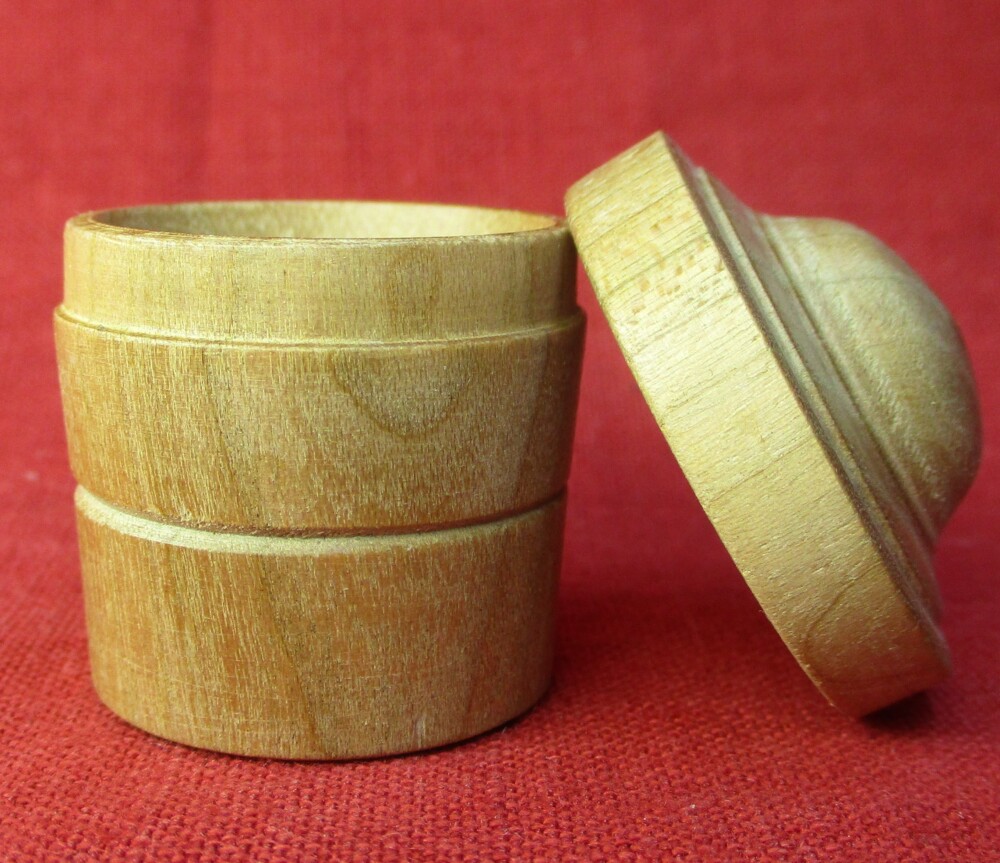
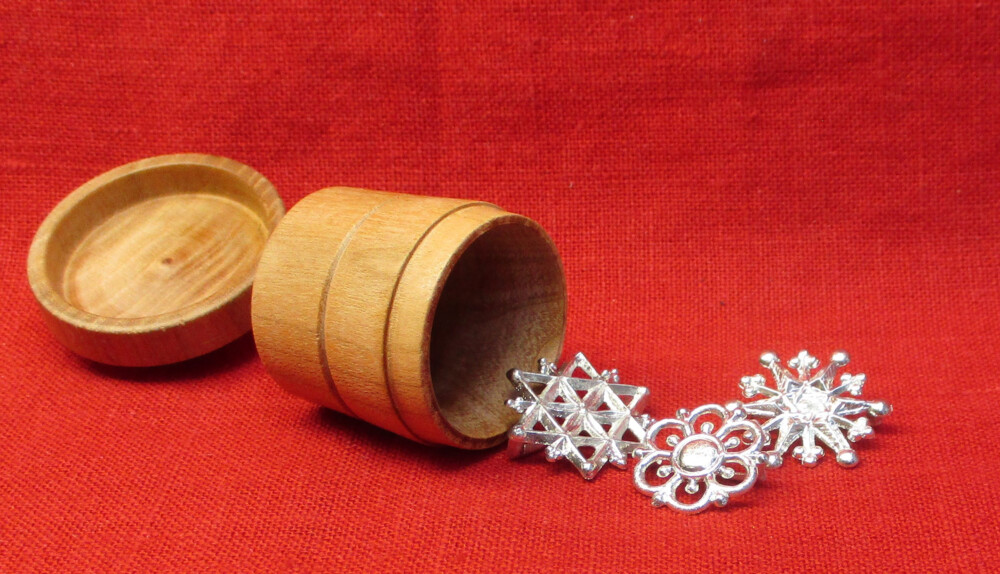
The finished box.

See our replicas of the brooches that were found in the original box.

Interested in seeing more boxes, both extant examples and in art? Mac has a Pinterest page on them.

Posted on Leave a comment

Parodies and Perversions

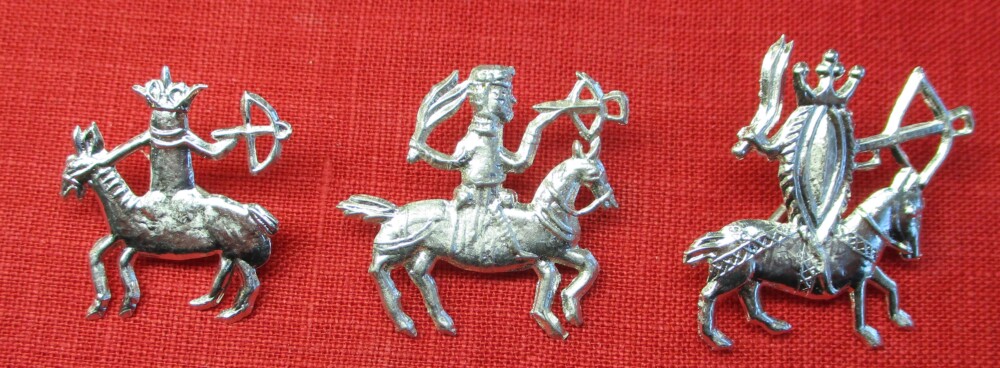
Three similar figures on horseback carrying crossbows. The riders are a penis, a man, and a vulva

We are accustomed to seeing reworked visual material in our day to day lives – American flags with the fields in various colors or with additional images overlaying the official design; blond “housewives” weeping, shouting, and pointing paired up with irritated cats; folks making improvised costumes to evoke famous paintings. It turns out medieval people were into it also – and some of those jokes ended up as obscene pewter dress accessories.

We are especially delighted by the naughty items that can be mistaken for their clean counterparts unless you are close enough to see the details – and of course, we like to make them. And bear in in mind that in a world without vision correction, many people would have to be very close to distinguish between these pairs.

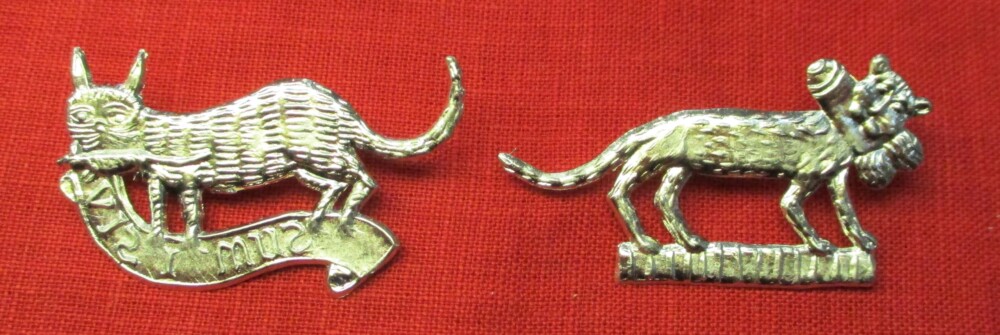
Two similar depictions of a cat carrying something in its mouth - in one case a mouse; in the other a penis.

Our most popular pair includes the Good Kitty and the Bad Kitty. The good kitty has caught a mouse. The bad kitty has definitely gotten hold of something it should not have. Of course, this is not quite as strange then as it would be now – a number of medieval and early modern images show independent penises flocking in trees like birds, being offered to prospective partners, flying through the air, or being carried by a cat.

So although it might be shocking to find that your companion’s brooch did not depict the ordinary cat you expected, at least the entire idea of a detached erect penis would not necessarily disturb you.

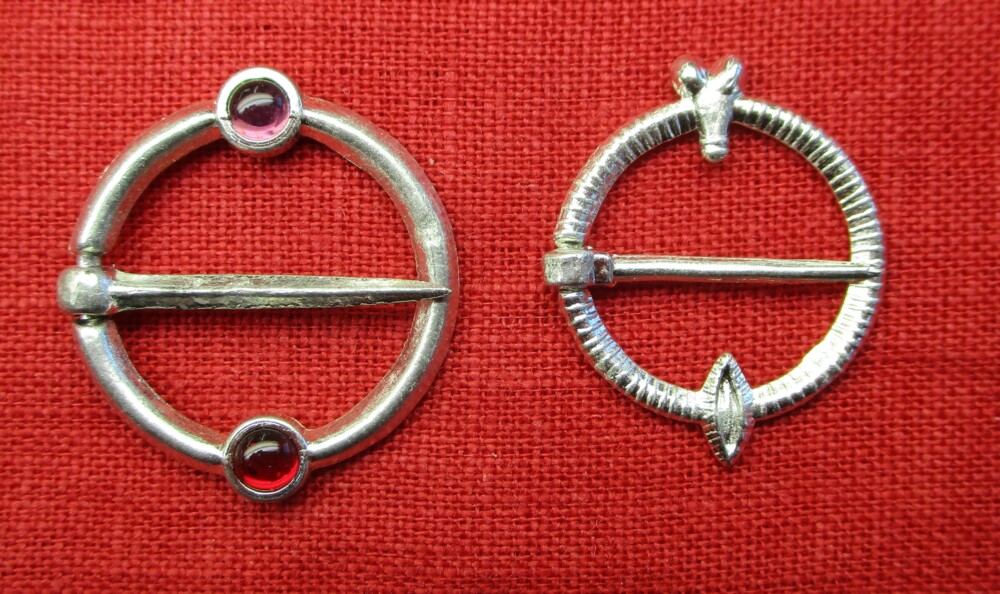
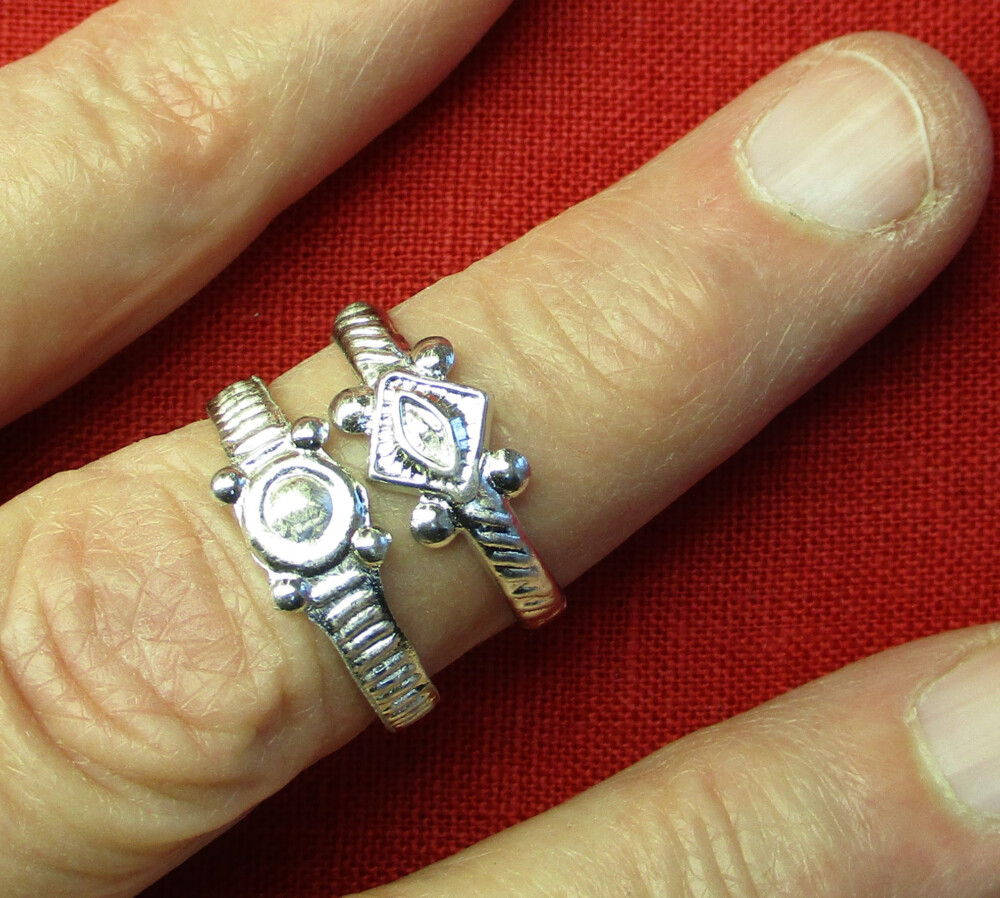
Some types of brooches are so ubiquitous that it would be easy to conceal the joke. Ring brooches are the most popular brooch form of the High Middle Ages, and they come in all sizes from humongous to quite petite. The small Naughty Ring Brooch, with its delicate little penis and vulva, is indistinguishable from dozens of contemporary round ring brooches from more than a yard/meter or so away. Similarly, the Pussy Ring is extremely discreet – designed just like other pewter rings – or rings made in other metals – with a central setting surrounded by four tiny “pearls”.

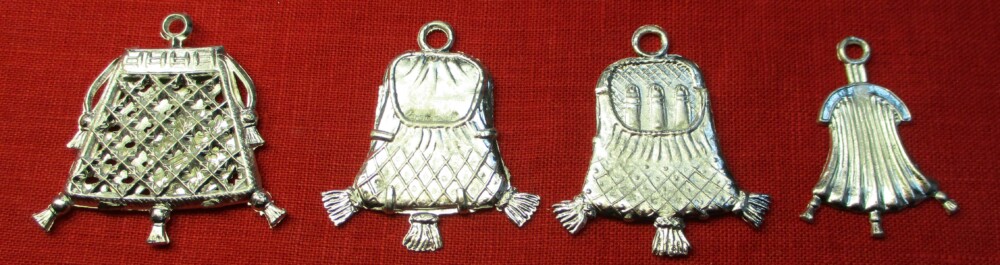
Three similar pendant purses. The first is an openwork drawstring purse and contains a pretend coin. The second looks like a closed frame purse on one side; the other side reveals it contains three penises. The third is a small, closed frame purse.

Purse brooches and pendants are also common, and may well have been thought of as a sort of good luck piece, guaranteeing that your real purse was never empty. We have three purse pendants, two respectable ones and then the Full Purse, which is doubly deceptive: it is utterly inoffensive on one side, but the wearer can flip it over to reveal that it contains three more of those wandering penises.

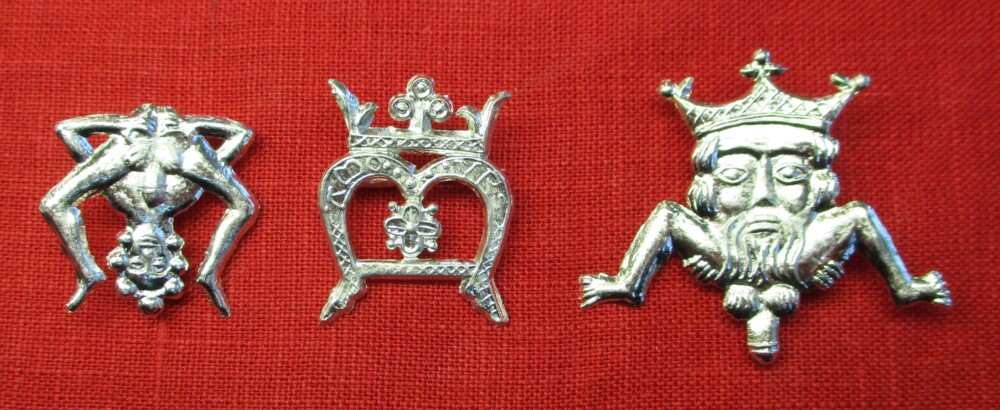
Three brooches with an over M shape. The first is a nude man leaning over to display his anus and penis. The second is a letter M with a crowns and a flower. The third is a grotesque male figure with crowned head, spread legs, and pendant penis.

M-shaped brooches are frequently found, in both precious and base metals. The initial probably usually refers to the Virgin Mary, although it may have other meanings, including Minne – courtly or romantic love. The brooch in the middle of the triplet set is a characteristic example of one of these harmless brooches – and it says AMOVRS, so we can be sure it is a love token. The acrobatic Mr. M has a nearly identical overall shape, while the KingDing shares the crown but not the exact outline.

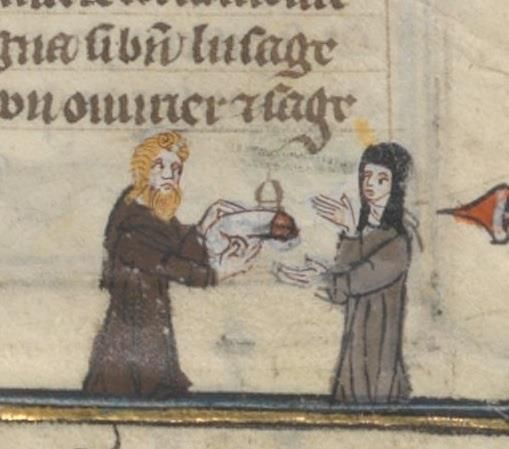
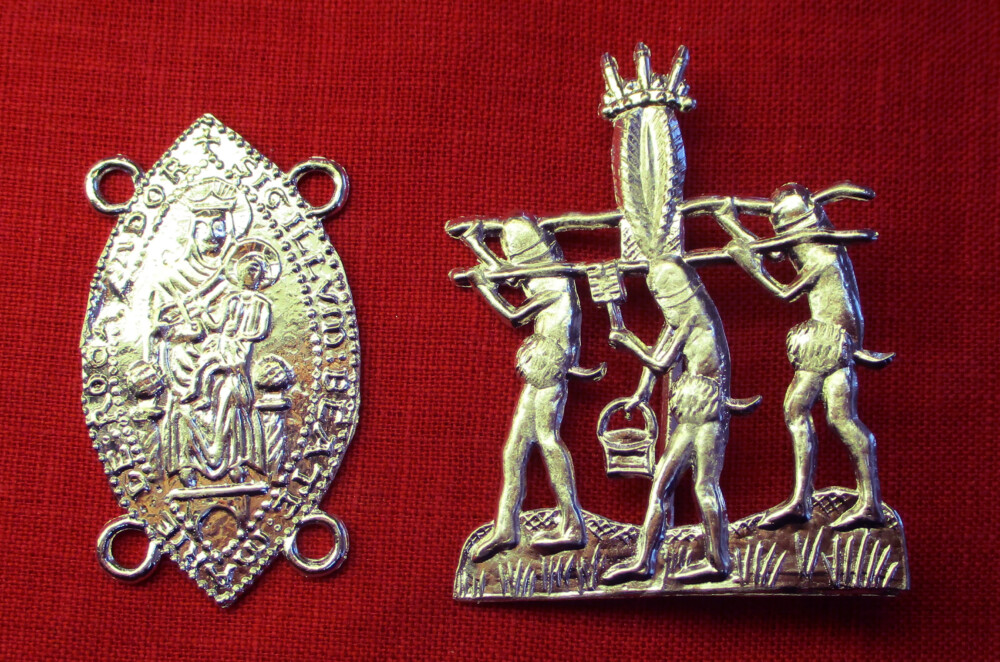
A relatively small number of naughty items present visual puns on religious motifs – although the Regina Terris brooch obviously displays a vulva as a religious icon carried in a procession, complete with a penis priest using an aspergillum to fling “holy water” around. The brooch we call Our Lady of Baloney is a brutally obscene, perhaps politically motivated, parody of images of Our Lady of Boulogne-sur-Mer.

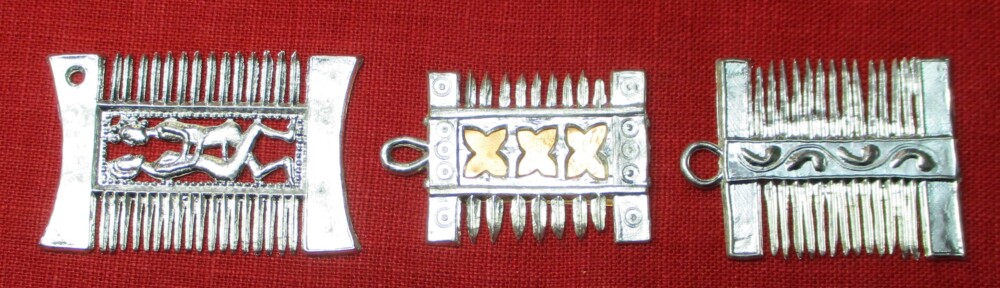
Three similar pendant combs with differing decoration in the middle between the teeth: the first with a scene of heterosexual intercourse; the second with an openwork decorative design; the third with a number of penises arranged along a ribbon

Everyday items are more likely to be depicted in both innocent and naughty versions than are divine persons. Here is a group of three combs – one ordinary and two with tasteless decoration. The incredibly cute Wee Willies Comb was so discreet that the Museum of London listed this as a pilgrim sign for St. Blaise for years before someone finally noticed the sinuous little line of penises.

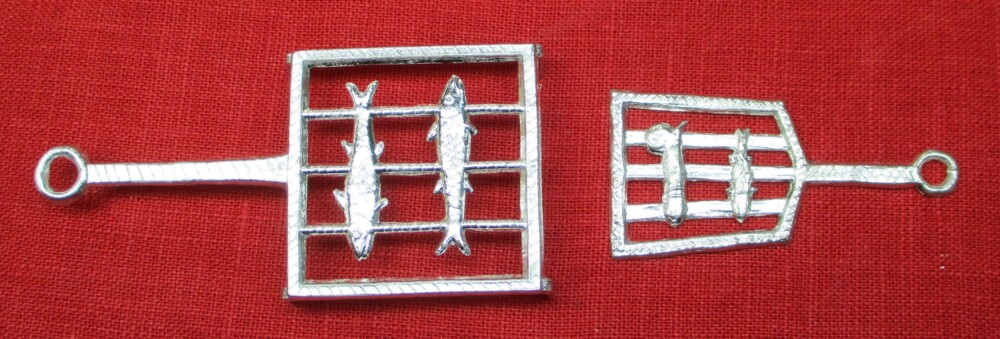
Two similar gridirons - one with two fish; the other with a fish and a penis.

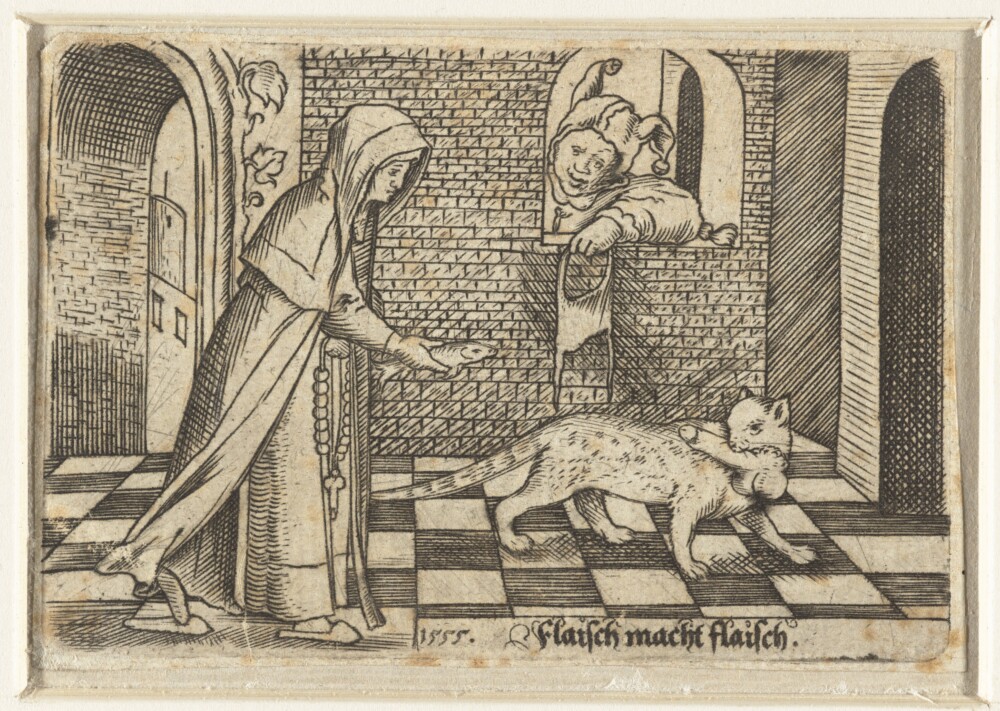
And finally, a pair of gridirons, the less seemly of which takes us back to the penis/fish thing we saw in that 16th-century print with the cat. The other is part of a child’s toy kitchen.

Check out our continuously updated page of Parodies and Perversions, where you can find all the twin and triplet sets we have produced, and get a little discount on a set if you want to keep your granny happy while amazing your friends.

Posted on Leave a comment

On making things meant to be identical quite similar

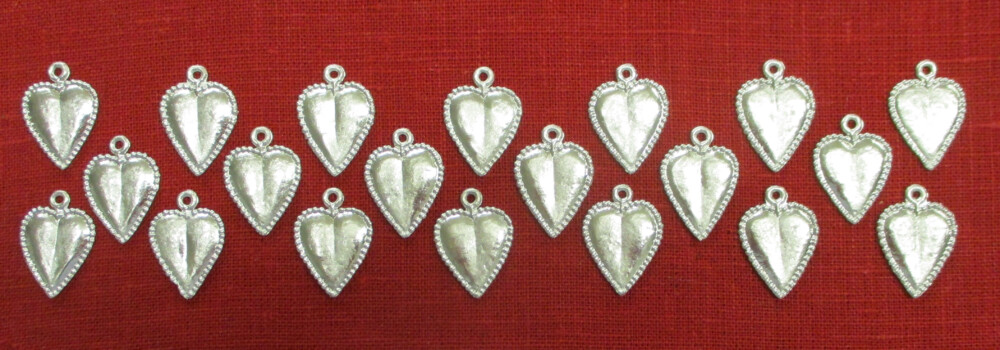
An array of heart spangles on a red background

We make molds for a lot of medieval gewgaws – roughly 525 items. Many of the smaller goods – spangles, buttons, chaplet decorations, belt mounts, clothing fasteners – come out of multi-cavity molds that cast three or more copies of the item.

It is important that the resulting castings are indistinguishable from one another except on very close inspection. We also want the mold to cast easily and completely (or nearly completely) every time. For this to happen, the mold cavities must be very similar, and they have to be laid out so that the metal fills each of them the same way. We try to choose the best mold design from a number of authentic layouts.

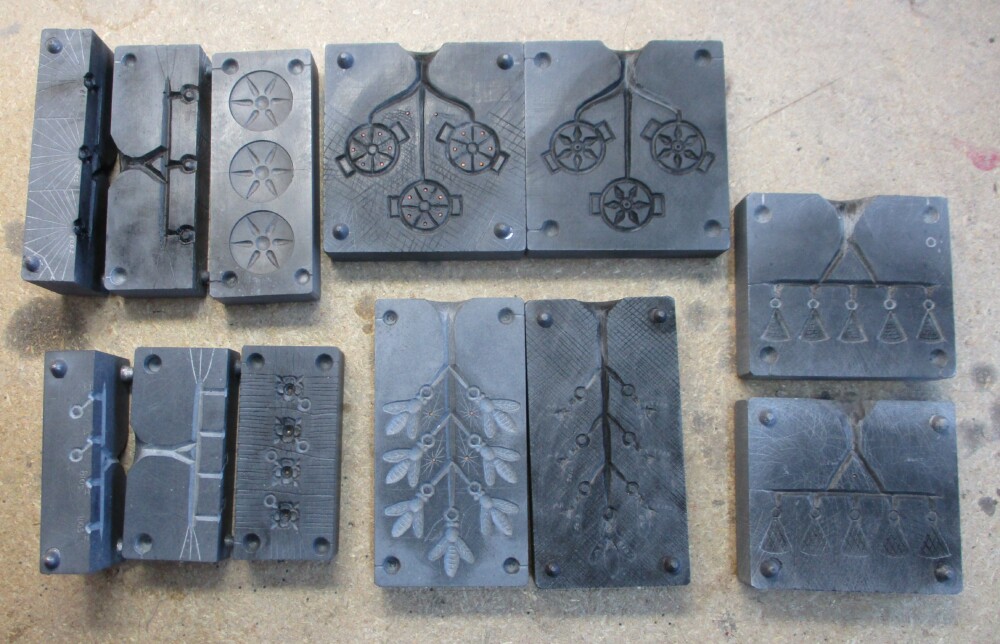
Multiple cavity molds: button, circlet decoration, spangle with stone, bee spangle, and triangular spangle

The two molds on the left are three part molds – the one to accommodate the button loop and the other so the stones can lie flat in the spangle mold while the metal pours in. The openwork star chaplet decoration mold and the bee spangle mold have cavities that branch off a central sprue. That middle sprue narrows as it descends and the lower feeds are narrower/thinner than the upper ones to balance the greater pressure to the lower parts of the mold. The mold for the triangular spangles equalizes the pressure in a different way, by arranging the cavities horizontally and splitting the main sprue to even out the flow and amount of metal to the various cavities.

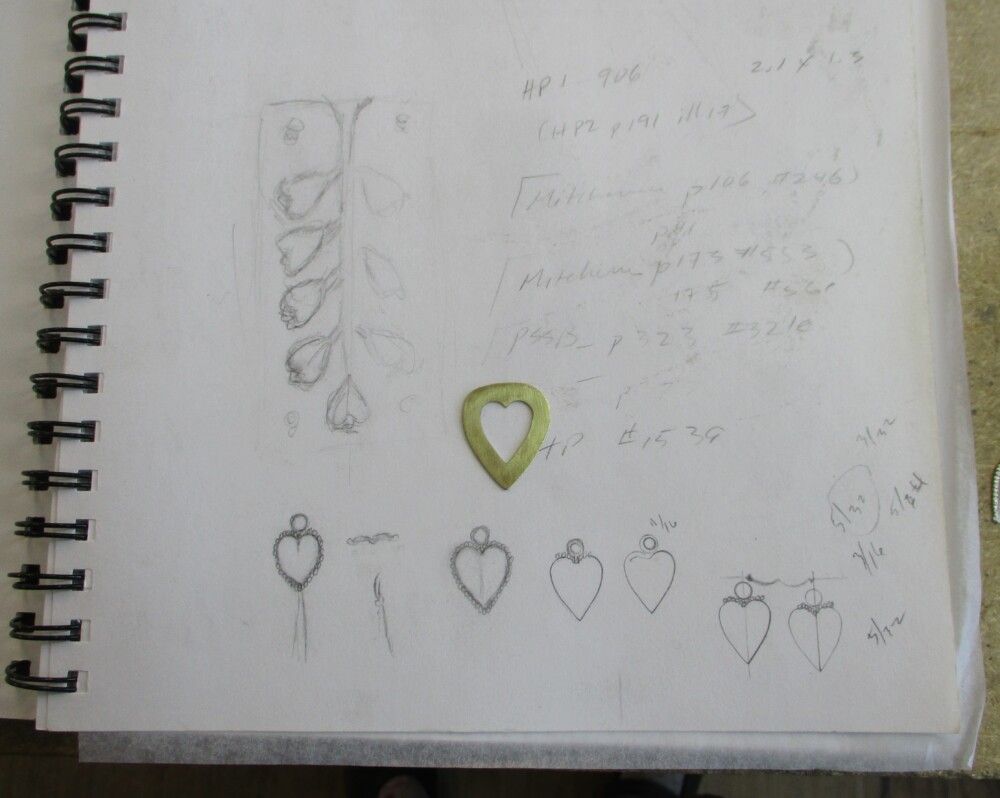
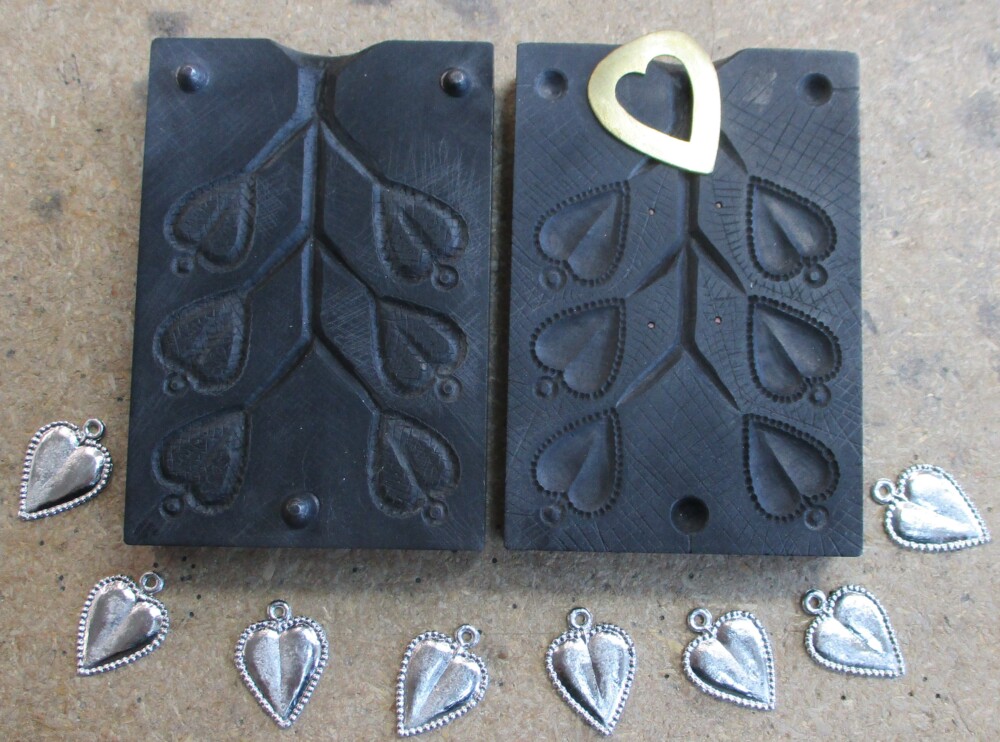
Notebook with sketches for heart spangle and mold with brass template.

This notebook page shows a layout we considered for the heart spangles, as well as some late sketches of the form the heart would take. (Preliminary sketches were on another page.) When we make round things we use a compass to lay out the pieces. But for items like the bees or the triangles – and the hearts – we employ templates to trace the shapes of the cavities. We have used cardboard and thin template plastic before; for the heart spangle Mac made a brass template to my final design. This let me trace the exact shape with a sharp needle on the stone – and also to trace the heart in pencil in my notebook to experiment with the beading, the loop, and so on.

Castings of heart spangle mold with complete hearts cut off and incomplete castings left to compare and correct.

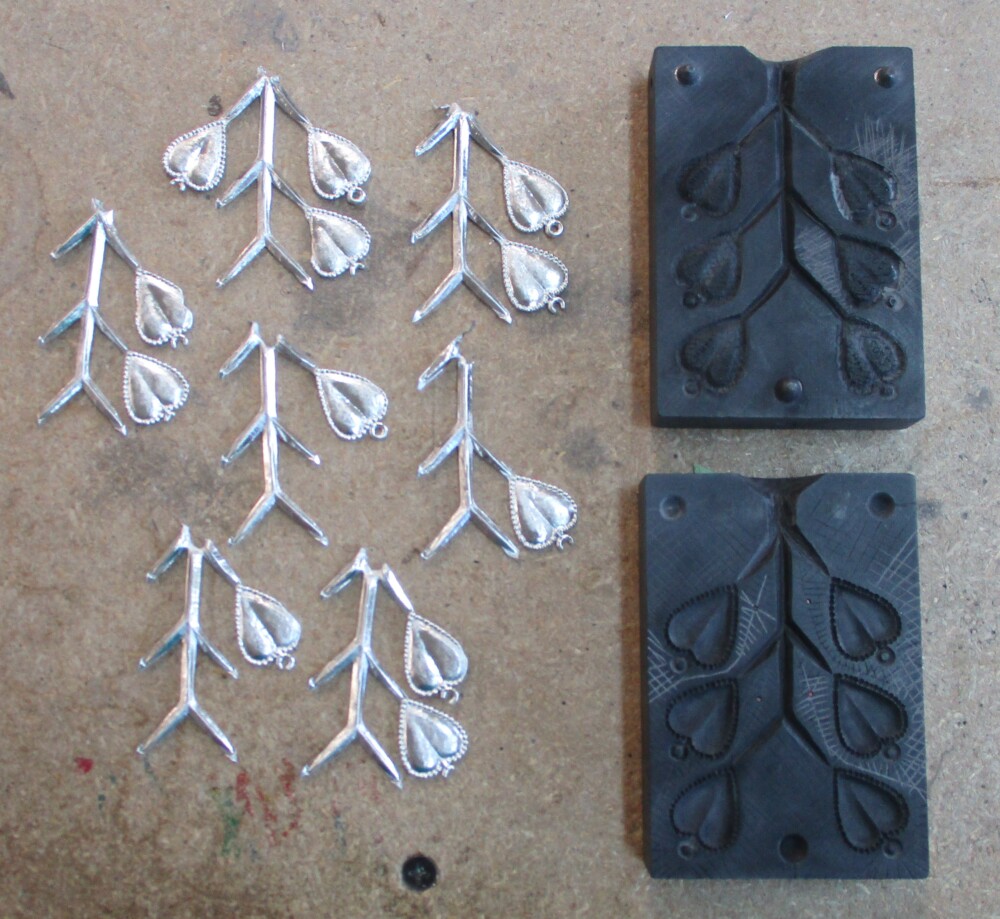
Hours of careful work into the project, I was getting many of the cavities to fill, most of the way, most of the time. I put my initials and the date on the back of each spangle, so that any examples that cast fully could be cut off, cleaned up, and sold. At this stage we keep every casting for examination. Clipping off the good examples, we lay out what is left to show where the repeating problems are. In the shot above we see that of the six cavities there is still trouble with the upper two hearts on the right. The loops are not casting, and upper heart is not filling to the edge. I corrected only the places that were not working, leaving the rest of the mold untouched. The lighter areas of the mold show where I extended and deepened the back under the beading where it was not casting, deepened the loops, and reinforced the venting both front and back.

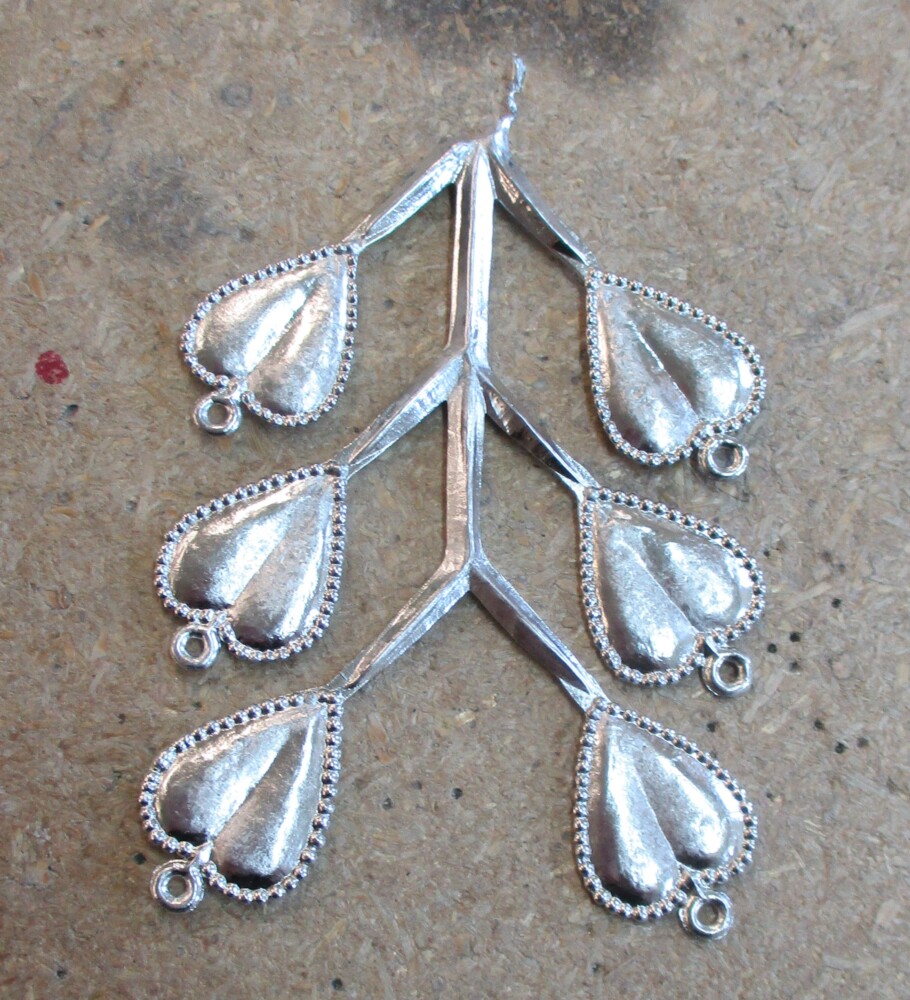
Complete cast of six spangles on sprue for heart spangle

By the time I filled the stock box, the mold still was not working perfectly every time, so the next time I cast I will continue tweaking the cavities, the sprues, and the venting. I’m almost there.

Mold for heart spangle with brass template and castings

The hearts themselves are also not perfectly identical – if you took a handful of them you could play “Spot the Difference” and sort them by mold cavity. But because I took care in design and layout, and worked as meticulously as I could, they are similar enough.

Posted on

Remaking an unsatisfactory mold

We used to offer a low-profile eyelet with three sewing holes and a pearled surface. It was copied after an original lacing eyelet in our collection. The eyelet was attractive and sturdy but the mold had problems.

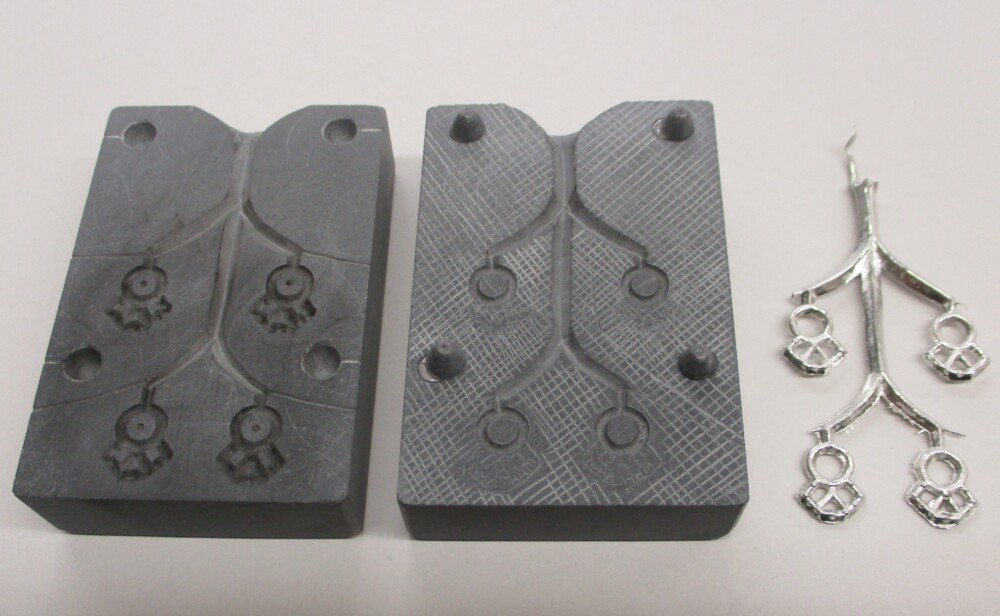
There are several ways to arrange the cavities in a gang mold – and all have their uses. Marianne, who made the first mold in 2006, used a vertical sprue with individual channels branching out for each eyelet. The channels travel towards the outside of the mold, then drop vertically with the eyelet cavities all descending at the same angle.

If a gang mold is properly made all the cavities fill perfectly every time. If it is not, some cavities do not fill or fill incompletely. Meanwhile, other cavities flash (have “fins” of unwanted metal that sneaks between the mold parts) and have to be cleaned up after casting. The problem with arranging the cavities vertically in a gravity-fed mold is that the lower cavities cast completely at a lower temperature (of mold and/or metal) than the upper ones – or more consistently – because the pressure is greater at the bottom. Usually you can adjust the spruing and gates so that most of the castings are satisfactory most of the time.

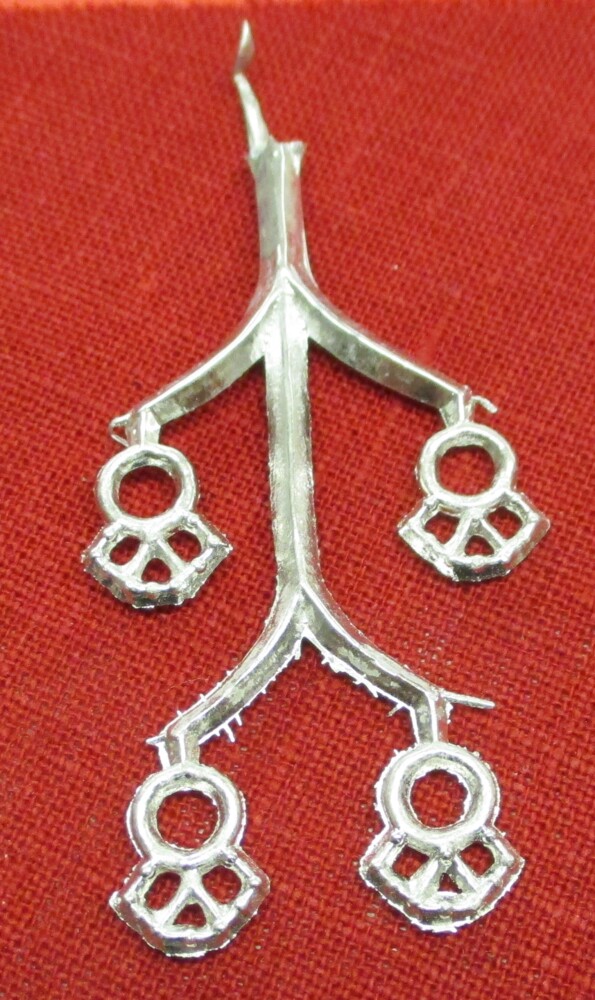
Old filigree eyelets mold

This mold shows one way to try solve that problem – the upper branching channels are thicker than the lower ones, feeding more, hotter, metal to the higher cavities. Making the mold was a prolonged struggle, with repeated unsuccessful efforts to balance the pressure to each casting. It is also a tightly fitted mold and needed extensive venting. We were in the midst of a period of exploration of venting technologies, and Marianne vented it – too aggressively – with a grid of closely spaced vents across the entire back mold valve. The result was that, even after all the fuss, castings usually had fewer than four complete eyelets and many of the complete eyelets were flashy.

Flashy casting from the old filigree eyelet mold

We continued to use the mold for a number of years, fiddling with metal temperature as we poured to try to control the flash; cleaning the flash off rapidly while cutting the eyelets from the sprue; throwing a lot of partial casts back into the pot, and cursing. We eventually introduced our pointy eyelets and let the filigree eyelets drop out of production.

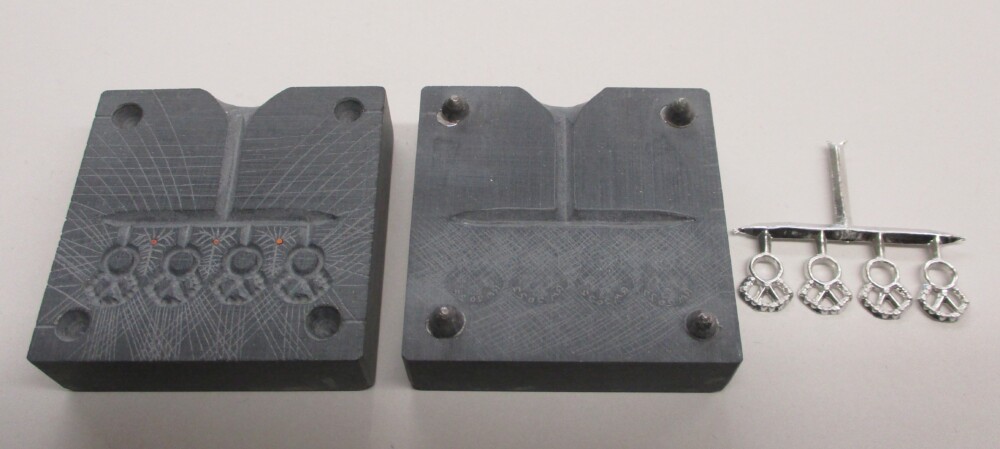
Mold for the pointy eyelets


The pointy eyelet mold is laid out on a different plan, with one sprue descending to a horizontal runner – and it worked well from the beginning. This arrangement equalizes the pressure to each cavity better, although you have to tweak the thickness of the runner to optimize it. This sort of mold is also sensitive to whether it is level when the metal is introduced, as a tilted mold may give you flashy castings at the lower end of the runner and incomplete ones at the higher end.

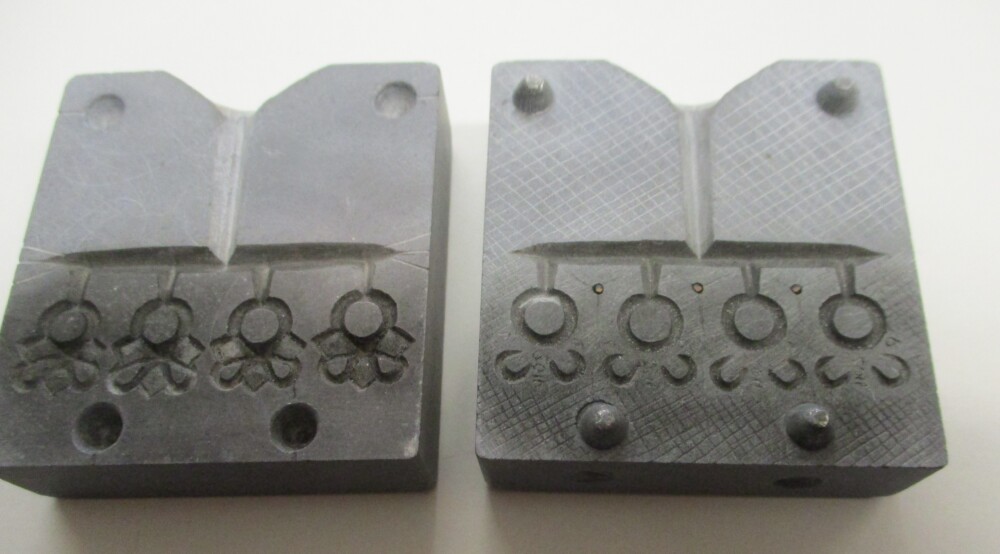
New filigree eyelets mold

This week Mac remade the filigree eyelet mold on the same pattern as the pointy one. The new mold is also vented very thoroughly – those are vents straight through the stone (filled with copper wire) between each of the cavities – but more expertly. We know more than we did 16 years ago, thank goodness.

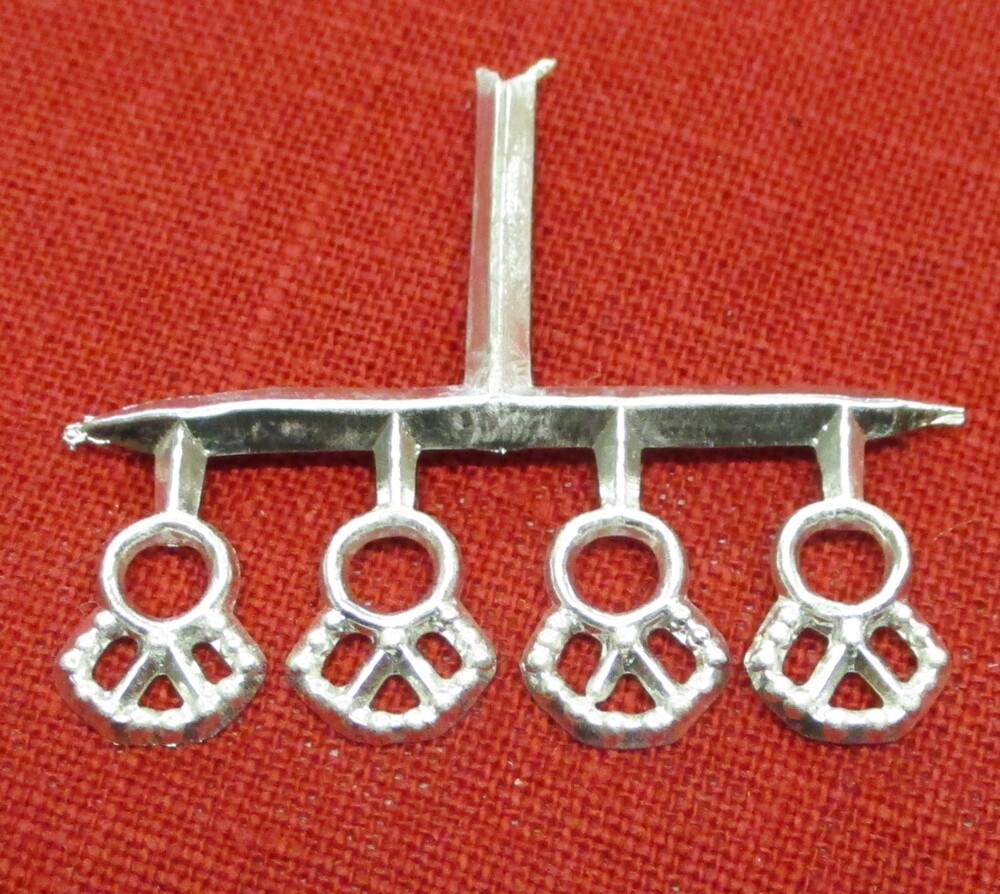
Clean casting from the new filigree eyelet mold

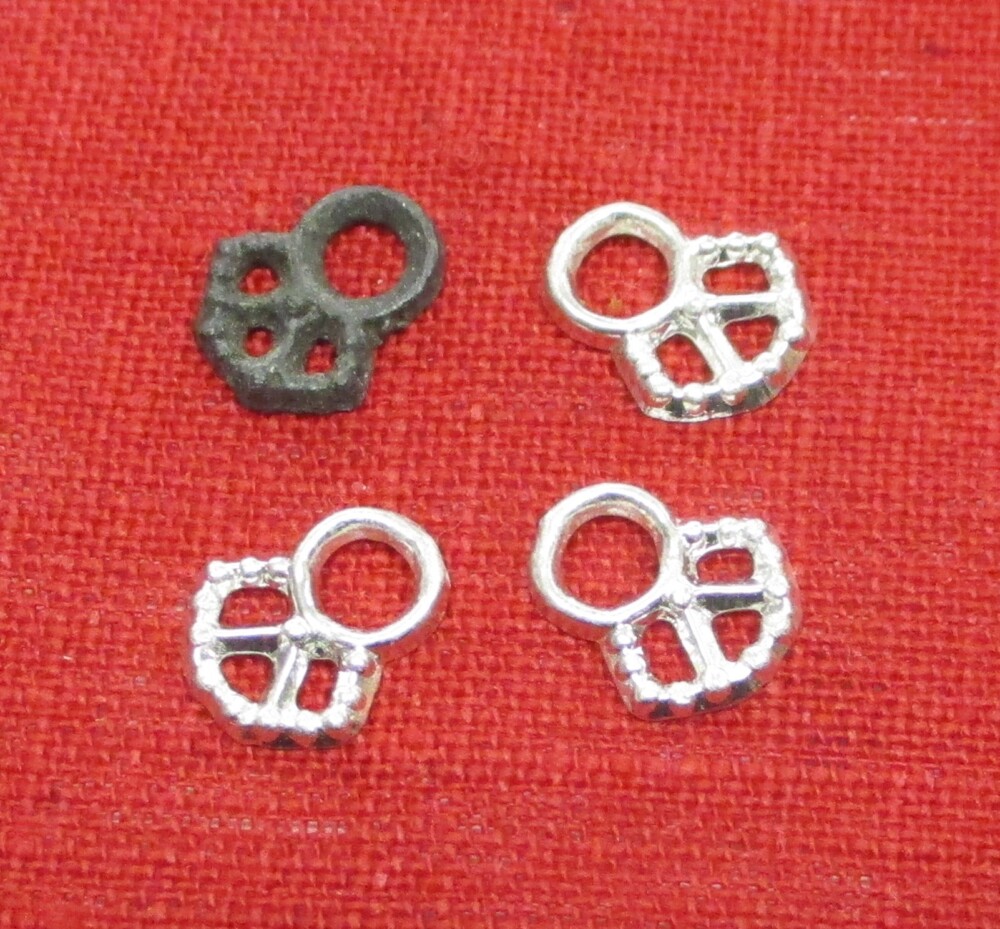
With the horizontal runner this mold consistently casts four perfect eyelets every time. We are offering this nice little lacing eyelet again.

Filigree lacing eyelets with original examplar